
Push Piers vs. Helical Piers:
Which Is Right for You?
When a foundation repair contractor tells you that your home needs “piers,” your next question should be: “Which kind — push piers or helical piers?” It’s an important question, too — these are the two most common foundation repair systems in the industry, and choosing the wrong one can mean the difference between a permanent fix and a problem that keeps coming back.
Here in Southern California and Arizona, most contractors rely on two technologies to stabilize sinking homes: Push Piers and Helical Piers. Both anchor your home to solid, load-bearing ground, but they get there in very different ways. Each one is designed for different soil conditions, structural loads, and types of projects.
At BristolFX, we use both methods because no two foundations are the same. The geology beneath your neighbor’s house might be completely different from what’s under yours — even on the same street. That’s why we tailor every repair to what’s actually happening beneath your property, rather than applying a one-size-fits-all solution. Below, we’ll walk you through the push piers vs. helical piers debate so you can have a more informed conversation with your contractor.
1. Hydraulically Driven Push Piers
Push piers tend to be the go-to choice for heavier structures — think two-story stucco homes or large single-story buildings with a lot of mass. They also perform exceptionally well when bedrock runs deep beneath the property. If you’re curious about how they fit into a broader repair strategy, take a look at our full range of foundation repair services.
How They Work
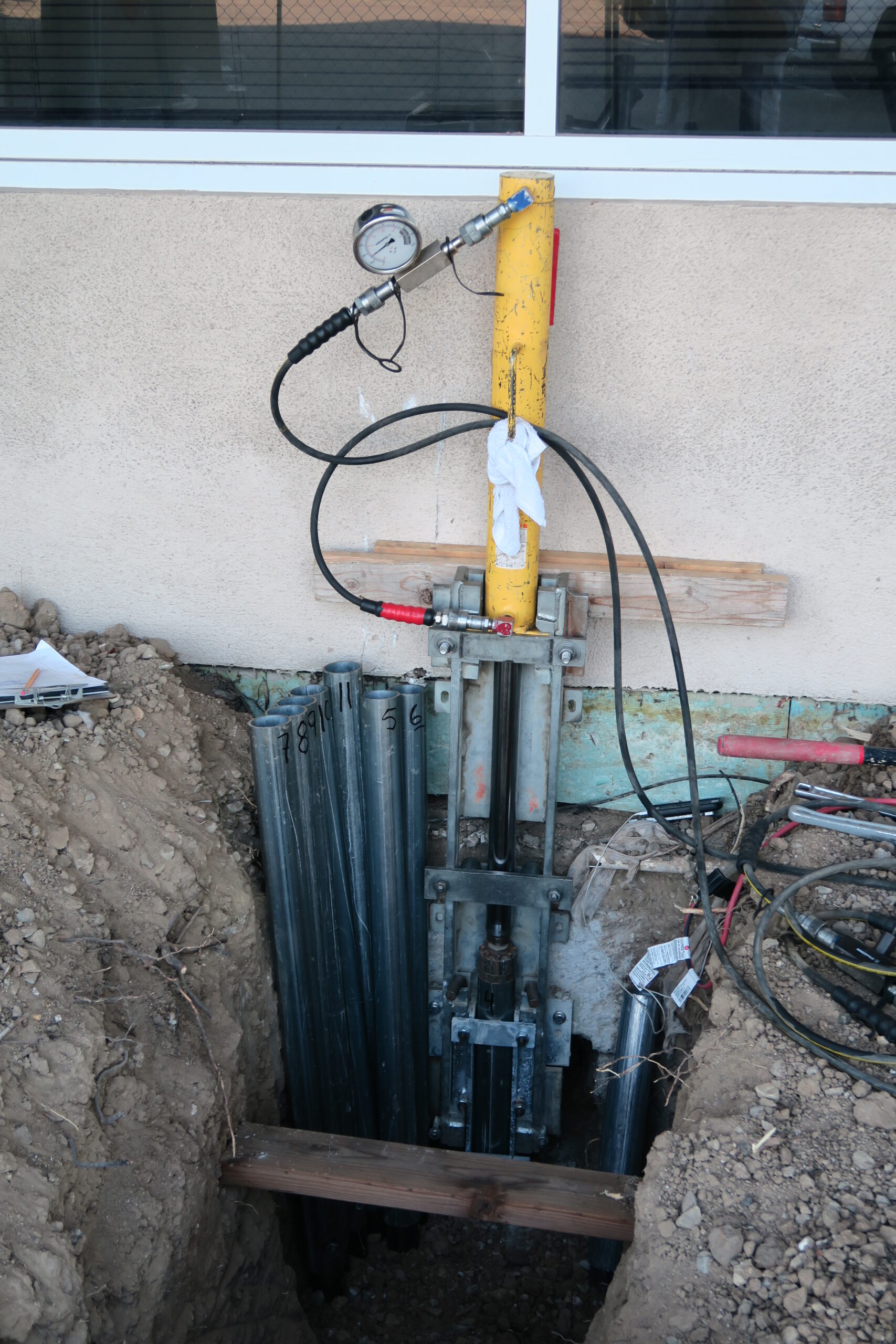
Picture sections of galvanized or epoxy-coated steel tubing, usually 2⅞” to 3½” in outside diameter, stacked end-to-end and driven straight down into the earth. BristolFX installs pier systems manufactured by Earth Contact Products (ECP), one of the country’s leading manufacturers of ICC-certified steel foundation systems.
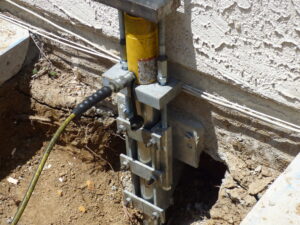
The process starts with a heavy-duty steel bracket that our crew bolts beneath your existing footing. From there, a powerful hydraulic ram uses the dead weight of your home as counter-resistance to push each pier section into the ground, one piece at a time. The pier keeps going deeper until it hits something it can’t push through — load-bearing strata like bedrock or dense, consolidated soils. In many parts of Southern California and Arizona, that can be anywhere from 15 to 75 feet down, and sometimes even deeper.
What Makes Them So Reliable
Here’s what really sets push piers apart from an engineering perspective: every single pier gets load-tested during installation, automatically. Because the hydraulic ram is pushing against the full weight of your home, the pier can’t advance unless it’s strong enough to support that weight. Once it reaches refusal — the point where it simply won’t go any deeper — you already know it can handle the load. There’s no guesswork involved. Depending on the bracket setup and soil conditions, each pier typically supports between 30,000 and 80,000 pounds.
There’s another practical benefit worth mentioning: push piers don’t make much of a mess. Unlike old-fashioned concrete pilings that displace large volumes of soil, these narrow steel tubes slip into the ground with minimal disturbance. That makes them a great option when you’re working close to a neighbor’s property line or near buried utilities.
The BristolFX Advantage
Push piers aren’t just for stopping a foundation from sinking — they can actually lift it back up. Once every pier has reached solid ground, our crew reverses the hydraulic system and gradually raises the structure, closing cracks and bringing everything back into alignment. Throughout the lift, we monitor pressures across all piers at the same time to make sure your home rises evenly and safely.
2. Helical Piers (Screw Piles)
If push piers are the heavy lifters, helical piers are the versatile all-rounders. They’re ideal for lighter structures like porches, decks, and single-story additions, and they really shine in areas where the soil is layered or unpredictable. They’re also a popular choice for crawl-space repair projects.
How They Work
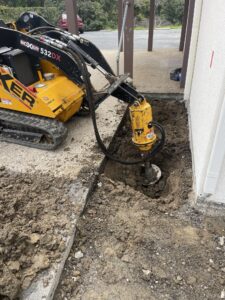
The easiest way to picture a helical pier is to think of a giant steel screw. Welded to the central shaft — which typically ranges from 1½” to 3½” in diameter — are one or more spiral-shaped plates that contractors sometimes call flights or fins. A compact hydraulic torque motor grips the top of the shaft and literally screws the pier into the ground, much like turning a wood screw into a piece of timber.
As the pier goes deeper, the installer watches the torque readings on the equipment. Once the pier reaches a specific torque value, measured in foot-pounds, the installation is done. That target torque directly correlates to how much weight the pier can hold, so the crew knows right away whether it’s reached sufficient capacity.
The Engineering Behind the Torque
This torque-to-capacity relationship is actually one of the most valuable things about helical piers. Engineers use an empirical constant called the torque-to-capacity ratio (Kt), which usually falls between 9 and 10 ft⁻¹ for standard square-shaft models. To put that in real numbers: if a pier hits 5,000 ft-lbs of torque during installation and the Kt factor is 10, its estimated ultimate capacity is 50,000 pounds. That means engineers can verify load capacity in real time, right on the job site, without scheduling expensive post-installation load tests.
What also makes helical piers so adaptable is the way they can be configured. The helical plates come in a range of diameters — commonly 8”, 10”, 12”, and 14” — and engineers can space them at different intervals along the shaft. This lets them design each pier to grip multiple stable soil layers instead of relying on one deep stratum. Both the push pier and helical pier systems we install at BristolFX are evaluated under ICC-ES Acceptance Criteria (AC358), the nationally recognized testing and certification standard for pier foundation systems.
This adaptability is especially important in parts of Arizona, where the ground beneath your home might alternate between caliche, expansive clay, and loose alluvial sand — sometimes all within the same property.
One more thing that makes helical piers unique: they don’t need the weight of a building to install. Push piers depend on the structure’s mass for driving force, but helical piers get all their energy from the torque motor. That means contractors can install them before a structure is even built, making them the natural choice for new construction, pre-loading applications, and tie-down systems for decks and retaining walls.
The BristolFX Advantage
We select every helix configuration based on geotechnical borings or probe data from your specific site. Whether it’s a pre-construction deep foundation, a lighter addition that needs stabilizing, or a soil profile that demands engagement at very specific depths, we customize the pier design to match what’s actually in the ground beneath your property.
Push Piers vs. Helical Piers: Comparison Table at a Glance
| Feature | Push Piers | Helical Piers |
| Primary Mechanism | Hydraulic force using building weight | Hydraulic torque motor screws into soil |
| Typical Shaft Diameter | 2⅞” – 3½” O.D. round tube | 1½” – 3½” square or round shaft |
| Best Soil Type | Deep bedrock or consolidated strata | Variable or layered soil conditions |
| Typical Depth | 15 – 75+ feet | 10 – 50+ feet |
| Capacity Verification | Load-tested during installation | Torque correlation (Kt factor) |
| Typical Load Capacity | 30,000 – 80,000 lbs per pier | 25,000 – 75,000 lbs per pier |
| Lifting Power | High — excellent for active lifting | Moderate — best for stabilization |
| Min. Structure Weight | Required (counter-resistance) | Not required |
| New Construction Use | Not typical | Ideal |
| Installation Noise | Quiet | Quiet |
| Vibration | None | None |
| Installation Time | Typically 1–3 days | Typically 1–3 days |
A Closer Look at the Engineering
Once you understand the basics of each system, it helps to know a few deeper technical details that separate push piers vs. helical piers — especially if you’re comparing proposals from different contractors.
How Each Pier Carries the Load
Push piers are what engineers call end-bearing piers. They transfer your home’s weight straight down through the steel shaft to a single strong layer at the very bottom. Some friction develops along the sides of the shaft as it passes through soil, but the real support comes from that solid contact point at the tip.
Helical piers work differently. Each spiral plate acts as its own individual bearing element, and the total capacity of the pier is the combined strength of all its plates. This means helical piers can spread the load across several soil layers at once, while push piers concentrate everything at one depth. In practice, this distinction often determines which system is better suited to the geology under your home.
Protecting Against Corrosion
Steel in the ground will eventually corrode — that’s just the nature of the material. The risk is especially real in parts of Arizona where alkaline and high-sulfate soil conditions are common. Alongside any pier installation, supplemental waterproofing and good drainage are critical for protecting your foundation long-term.
That said, both pier types are built to last. Push piers typically come with hot-dip galvanizing or epoxy coatings, and the steel walls are thick enough to provide a built-in corrosion buffer. Helical piers get similar treatments — galvanizing, higher-grade steel alloys, or both. In particularly aggressive soil, engineers may also call for sacrificial anodes or extra-thick walls to push the expected service life well past 75 years. And if your foundation has already taken corrosion damage, crack injection and corrosion repair can restore what’s been lost.
Dealing with Lateral Forces
Not all foundation stress comes from above. Sometimes the ground pushes sideways — from expanding clay soils, for example, or from hillside creep on sloped properties. In these situations, helical piers can offer a slight edge because their spiral plates resist lateral displacement better than smooth-walled push pier tubes. That said, both systems can be reinforced with lateral tiebacks or installed at an angle (called a battered installation) when significant side loads are expected.
So, Which One Does Your Home Need?
The honest answer? You can’t figure this out just by looking at the cracks in your walls. The right system depends on a combination of factors that are unique to your property:
Your home’s weight plays a big role. Heavier structures are natural candidates for push piers because the building itself provides the driving force — and heavier buildings give the hydraulic system more power to lift the foundation back to level. Lighter structures might not weigh enough to drive push piers effectively, which is where helical piers step in.
How deep the bedrock sits matters just as much. If stable ground is very deep, push piers may be the most efficient way to reach it. But if solid soil layers exist at moderate depths, helical piers can grip those layers without needing to go all the way down to bedrock.
The type of soil under your home is arguably the most important factor. Clay, sand, caliche, and fill all behave very differently under a building’s weight. Arizona is especially tricky — the Arizona Geological Survey has documented how widespread expansive and collapsing soils are across the state, and these conditions require careful engineering to address. In some situations, contractors will also inject polyurethane geotechnical foam alongside piers to fill underground voids and firm up loose soil.
Whether you’re building new or repairing existing is the final piece of the puzzle. Helical piers don’t need a structure on top to install, so they’re the clear choice for pre-construction deep foundations. Push piers, on the other hand, are specifically designed for stabilizing and lifting buildings that are already standing.
Stop Guessing — Get a Professional Diagnosis
Every foundation problem is different, and the push piers vs. helical piers decision isn’t one you should make on your own. The only way to know which system your home actually needs is to have a professional take a look. If you’d like to do some homework beforehand, the USDA Web Soil Survey is a free tool that lets you pull up detailed soil data for any address in the country — it’s a great starting point.
When you’re ready for a definitive answer, BristolFX provides 24–48 hour assessments that include a visual inspection, elevation survey, and subsurface analysis. We’ll tell you exactly which pier system — or combination of systems — will permanently solve your settlement issue. If you have questions before booking, check out our FAQ page or browse examples of our past projects to see what these pier systems look like in action.
Contact Us Today for a Free Structural Evaluation →
Don’t wait for cracks to widen or doors to stick even more. The sooner you act, the more options you’ll have — and the less it will cost. We also offer flexible financing options to help make foundation repair work with your budget.