

BRISTOLFX FOUNDATION EXPERTS
Foundation Tech, Inc. d.b.a. Bristolfx
CA: (661) 294-1313 | AZ: (928) 767-7789
bristolfx.com
Why Is My Foundation Sinking?
The Complete Homeowner's Guide to Foundation Settlement, Heave, Causes, Warning Signs, and Repair Options Matched to Your Budget
Published by Bristolfx Foundation Experts | bristolfx.com | CA CSLB #991221 | AZ ROC #354312

Foundation problems — whether sinking OR heaving — affect 1 in 4 American homes and cause more annual financial damage than all natural disasters combined. (Source: ASCE / HUD)
📋 Table of Contents
- The Bristolfx Diagnostic Philosophy — Why Diagnosis Comes Before Repair
- The Scale of the Problem — Key Statistics
- Foundation Settlement — What It Is and Why It Happens
- ⭐ Foundation Heave — The Misdiagnosed Problem That Destroys Homes
- Did You Cause This? Honest Answers for Homeowners
- Warning Signs and How to Read Them
- How Bristolfx Diagnoses Your Specific Problem
- Repair Solutions — Why Each Works, Best Used For
- Good / Better / Best — Repair Options by Damage and Budget
- What Does Repair Cost? — 2026 Data
- Prevention — What You Can Do Today
- Frequently Asked Questions
- Scientific Sources
The Bristolfx Diagnostic Philosophy — Why Diagnosis Comes Before Repair
Most foundation repair companies send someone to your door with one goal: sell you a repair. They have a preferred method — usually the most expensive one — and they diagnose every problem as requiring that method.
Bristolfx operates differently. We diagnose first. We recommend second.
This matters more than most homeowners realize — and it is exactly where Bristolfx differs from every other foundation contractor you may have called.
The same crack in your wall can have a dozen different causes. Yes — it could be foundation settlement. Or foundation heave. But it could also be something far simpler and far less expensive. And knowing the difference is everything.
40% of the inspections our principal inspector personally performs result in no foundation repair recommendation at all. The problem is something else entirely — and our job is to find it, tell you the truth about it, and point you toward the right solution regardless of whether that solution benefits us financially.
That commitment to honest diagnosis is not a marketing slogan. It is the reason the majority of our new clients come to us through referrals — from homeowners we told did not need foundation work.
Here Is What We Look For Before We Ever Discuss Foundation Repair
Green Wood — The Hidden Culprit in New and Recently Built Homes
The lumber used to frame your home is cut from living trees. That wood still contains significant moisture when it leaves the mill — what builders call "green wood." As your home dries out over months and years, that wood shrinks, twists, and warps. The specific behavior depends on which part of the tree each stud or beam came from — heartwood moves differently than sapwood, and no two pieces behave identically.
This completely normal drying process creates stress throughout your home's frame that produces cracks, sticking doors, and uneven floors — symptoms that look exactly like foundation movement but have absolutely nothing to do with your foundation.
Roof Leaks and Plumbing Leaks — The Most Commonly Missed Diagnosis
Water entering through a compromised roof penetrates your ceiling, saturates your wall framing, and causes the same warping and twisting as drying green wood — except it happens repeatedly with every rain event. During our inspections, we routinely find water stains on ceilings that no one has investigated. Sometimes that stain is from a roof leak. Sometimes it is from a plumbing line running above. Either way — the resulting wood movement produces every warning sign homeowners associate with serious foundation damage.
A roof leak repaired by a licensed roofer costs a fraction of unnecessary foundation work. A plumbing fix costs far less than pier installation. Pointing you toward the right professional — even when that professional is not us — is exactly what we do.
Before we recommend any foundation repair — before we discuss piers, waterproofing, or any structural solution — we investigate every alternative explanation. We look at your framing. We look at your ceilings. We look at your roof. We measure your foundation elevations precisely. We tell you what we actually found.
Unfortunately that approach is not standard in this industry. Too many inspections are performed not by diagnosticians but by salespeople — and salespeople find foundation problems regardless of what is actually happening. We find the actual cause. Whatever that cause turns out to be.
That is the Bristolfx difference. And it is why our customers refer us to the people they trust most.
Every Bristolfx inspection begins with a structured diagnostic process — not a sales process. We evaluate elevation measurements, crack patterns and directions, moisture indicators, soil conditions, and the history of the structure before recommending any repair. We then present findings in plain language, explain exactly what is happening and why, and offer repair options matched to the severity of damage — including lower-cost options when the damage warrants them.
Our goal is not to sell you the most expensive solution. Our goal is to sell you the right one.
⚠ If any foundation contractor recommends a repair without first measuring elevation changes, examining soil conditions, and explaining the specific cause of your problem — get a second opinion before signing anything.
We also understand that foundation repair feels like an unwelcome financial burden to most homeowners. It doesn't make your home more beautiful. It doesn't add a room or update a kitchen. It's invisible infrastructure — and it's expensive. We respect that. Which is why this guide presents repair options at multiple investment levels — so you can make an informed decision that matches both your foundation's needs and your financial reality.
Diagnosis First. Repair Second. Always.
Free professional inspection — elevation measurements, written findings, and repair options at multiple price points. Zero obligation.
Schedule Free Diagnosis 📞 CA: (661) 294-1313 📞 AZ: (928) 767-7789The Scale of the Problem — Key Statistics
The American Society of Civil Engineers estimates that expansive soils cause more annual financial damage to property owners than tornadoes, floods, earthquakes, and hurricanes combined. Unlike those dramatic events, this damage happens silently — over months and years — which is why so many homeowners don't act until damage is severe and expensive.
Sources: Mintek Resources — ASCE Citation | G.L. Hunt Foundation Repair — HUD Citation
Foundation Settlement — What It Is and Why It Happens
Settlement is the downward movement of your foundation. It happens when the soil beneath your foundation can no longer fully support the weight of the structure above it. Settlement is the more commonly discussed of the two primary foundation movement types — but it is frequently confused with its opposite: heave.
The most common causes of settlement in Southern California and Arizona are expansive clay soils that shrink during drought cycles, fill soil compressing under structural weight over time, soil erosion creating voids beneath slabs, plumbing leaks saturating and weakening bearing soils, and seismic activity disrupting soil structure. Each cause requires a different approach to permanent repair.
Settlement is rarely uniform. When one corner or section of a foundation sinks faster than the rest — known as differential settlement — the structural frame of the home is put under uneven stress. Door frames rack. Drywall cracks diagonally. Floors slope. Gaps form at walls and ceilings. These are the visible signals that differential settlement is occurring.
⭐ Foundation Heave — The Misdiagnosed Problem That Destroys Homes

The same wall crack can indicate either foundation settlement OR foundation heave. Only a professional diagnostic evaluation — including elevation measurements — can determine which is occurring. The repair for each is completely different.
What Is Foundation Heave?
Foundation heave is the upward movement of your foundation — the opposite of settlement. Instead of your foundation sinking into the ground, the soil beneath it is expanding and pushing it upward. Heave most commonly affects slab-on-grade foundations because a slab has less structural weight to resist upward force than a deeper perimeter foundation.
Imagine a dry kitchen sponge. Pour water on it and it swells — getting thicker in every direction. The soil beneath your foundation behaves exactly the same way. When expansive clay soil beneath a slab absorbs water and swells, it pushes upward because that is the direction of least resistance. The surrounding soil, the weight of the structure, and bedrock below all constrain lateral and downward expansion — so the force goes up, into your foundation.
The result: your foundation moves upward — unevenly — in the areas where the most soil moisture has accumulated. One room's floor rises while an adjacent room's stays level. The same symptoms appear as settlement: doors stick, walls crack, floors feel uneven. But the cause and the cure are completely opposite.
Why Heave Is So Frequently Misdiagnosed
Foundation heave and foundation settlement produce nearly identical visible symptoms: wall cracks, sticking doors, uneven floors, gaps at walls and ceilings. According to forensic engineers who specialize in foundation movement, all three of the primary movement types in clay soil regions — heave, subsidence, and settlement — are commonly misdiagnosed even by experienced contractors.
The danger: If heave is diagnosed as settlement and piers are installed, the piers push the foundation back down — directly fighting the upward soil pressure. The soil continues pushing up. The piers become ineffective. You've spent $15,000–$25,000 on the wrong solution and the problem continues.
The correct sequence: Measure elevation. Identify direction of movement. Diagnose cause. Then recommend repair.
Heave vs. Settlement — Side-by-Side Comparison
⬆ Foundation Heave (Upward Movement)
- Floor in the center of the room is higher than the perimeter
- Slab has a noticeable dome or hump in the middle
- Cracks in floor tile that radiate outward from the center
- Doors stick at the top of the frame
- Gaps at the bottom of walls where they meet the floor
- Plumbing problems (heave compresses drain lines)
- Problem often worsens after heavy rain or irrigation
- More common in newer construction (first 5 years)
⬇ Foundation Settlement (Downward Movement)
- Floor in the corners or perimeter is lower than the center
- Foundation has sunk in a specific area
- Diagonal cracks at corners of door and window openings
- Doors stick at the sides or bottom of the frame
- Gaps at the top of walls where they meet the ceiling
- Exterior cracks visible in foundation or brick veneer
- Problem often worsens during dry seasons or drought
- More common in older construction or after seismic events
Important: These patterns are generalizations — not absolutes. Only professional elevation measurements taken at multiple points across your foundation can definitively determine the direction and extent of movement. This is why a proper inspection is non-negotiable before any repair is undertaken.
The 6 Causes of Foundation Heave in Southern California and Arizona
1. Expansive Clay Soil + Seasonal Rainfall
The most common cause of heave in Southern California. When drought-parched clay soil is suddenly exposed to heavy rainfall — a common pattern in our climate — it absorbs water rapidly and expands dramatically. The soil beneath your slab has nowhere to go but up. This type of heave often occurs in the center of the slab where soil conditions differ from the perimeter, causing the characteristic dome shape.
📎 The Constructor — Causes of Foundation Heave, Geotechnical Engineering | USGS Swelling Clays Map — Geology.com
2. Plumbing Leaks Beneath the Slab
A slow leak from a supply line, waste line, or HVAC condensate drain beneath your slab can introduce water into the bearing soil silently for months or years. The saturated soil expands and pushes upward. This type of heave is often concentrated in a specific area corresponding to the leak location and may be accompanied by warm spots on the floor (hot water line) or unexplained increases in water bills.
3. Over-Irrigation and Landscape Watering
Sprinkler systems, drip irrigation, and lawn watering that consistently direct water toward the foundation can saturate bearing soils and trigger heave. This is especially common in newer communities where landscaping is installed after the home is built and irrigation is set to water close to the foundation perimeter. Heave from this cause often develops gradually over the first few years of occupancy and is directly correlated with irrigation activity.
4. Tree Root Growth Beneath the Slab
Tree roots growing beneath a slab physically lift the concrete from below as they expand in diameter. Unlike moisture-driven heave which affects broad areas, root-driven heave is typically localized — occurring directly beneath or alongside a specific tree. The crack pattern in root-driven heave often follows the direction of root growth and may be visible as a ridge or raised section running in a consistent direction.
5. Poor Drainage Directing Water Under the Foundation
When yard grading, downspouts, or drainage systems direct water toward rather than away from the foundation, that water accumulates beneath the slab. In clay soil, this concentrated moisture causes localized heave in the areas receiving the most water. This is particularly common along foundation perimeters adjacent to planters, garden beds, or areas where downspouts terminate near the structure.
6. New Construction Settlement of Surrounding Soils
During construction, soil excavated around the foundation perimeter is exposed to air and dries out. After the home is built, rainfall and irrigation reintroduce moisture to these dried perimeter soils, causing them to expand inward and upward. This is why heave most commonly occurs in the first few years after construction — it represents the perimeter soil returning to its natural moisture equilibrium.
📎 The Constructor — Causes of Foundation Heave, Geotechnical Engineering
Did You Cause This? Honest Answers for Homeowners
One of the first questions homeowners ask — often with anxiety — is whether they did something wrong. The honest answer is: sometimes yes, sometimes no, and sometimes it doesn't matter because what matters now is fixing it correctly. Here is a transparent breakdown:
You have a sprinkler system watering within 2 feet of the foundation. You have landscape beds with heavy watering adjacent to the house. You have known plumbing leaks that were not repaired promptly. You planted large trees close to the foundation. Your gutters are chronically clogged or your downspouts terminate at the foundation. Your yard slopes toward the house.
What it means: These are correctable conditions. Fixing the source and then addressing the resulting foundation damage is the complete solution.
The problem appeared after a major rain event or after an extended drought ended. Your home is more than 20 years old and was built on fill soil or a hillside. You live in the San Fernando Valley, LA Basin, or any hillside community. Your home experienced shaking from a seismic event. The problem appeared in the first 3–5 years after construction.
What it means: The cause is geological or structural — beyond any homeowner's control. Focus on the repair, not the blame.
You have a slab leak that was recently discovered. Your foundation began moving after major landscaping changes. Movement began after a neighbor's construction project. Problem appeared after a municipal water main break nearby. You are in an area with known liquefaction or landslide hazard zones.
What it means: A professional assessment can often identify contributing causes — some of which may be covered by insurance or be the responsibility of a third party.
Whether or not homeowner activity contributed to the problem has no bearing on the urgency of repair. Foundation movement — regardless of cause — continues to progress and worsen over time. The damage done does not reverse itself when the cause is removed. Addressing both the cause and the resulting structural damage is always the complete solution.
Warning Signs and How to Read Them
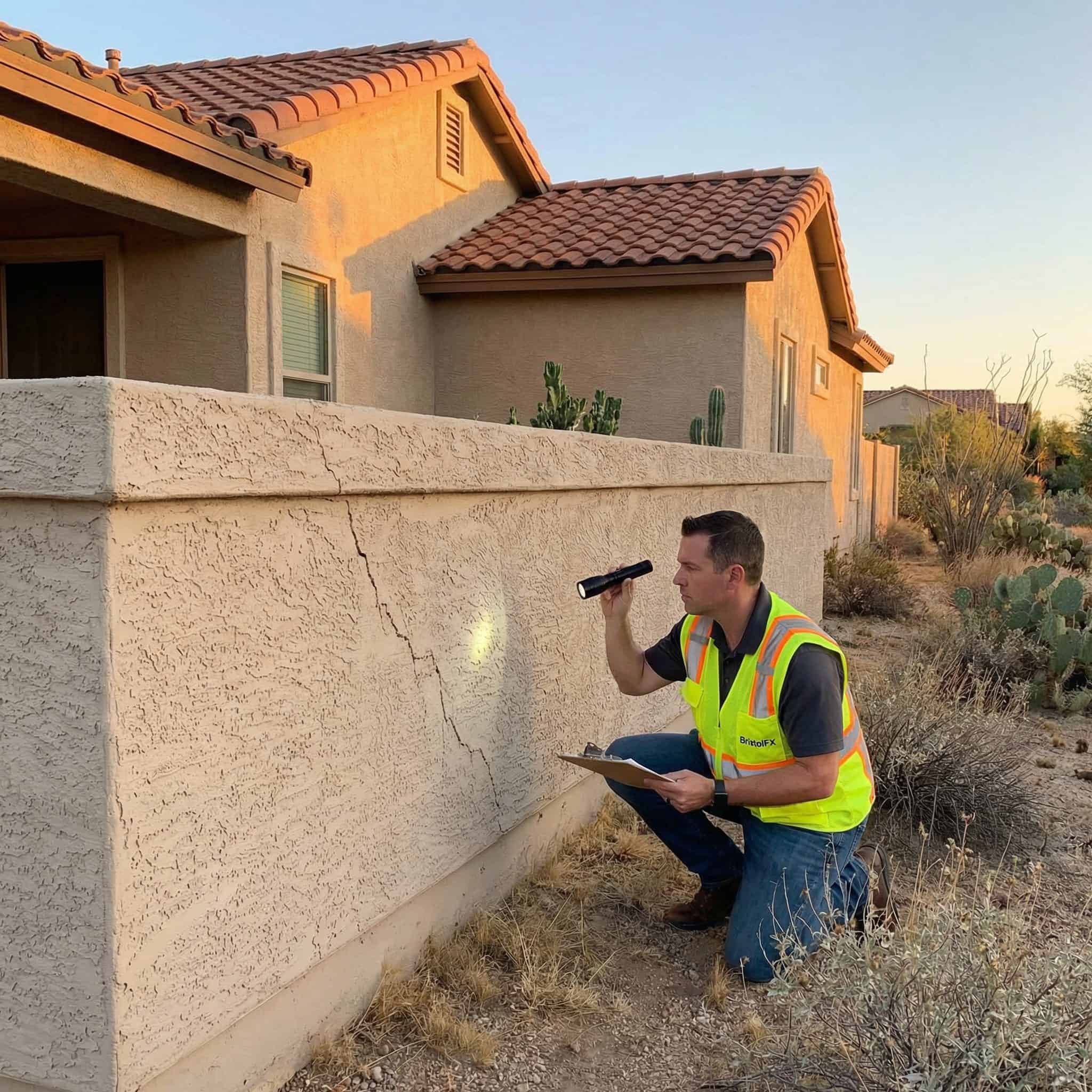
A Bristolfx inspector examines a foundation crack — the direction, width, location, and pattern of every crack tells a diagnostic story. Early evaluation prevents costly misdiagnosis.
| What You See | Could Indicate | Direction | Urgency |
|---|---|---|---|
| Diagonal cracks at window/door corners | Differential settlement | ⬇ Sinking | 🟡 Evaluate soon |
| Horizontal cracks in foundation wall | Active soil pressure, possible bowing | ↔ Lateral | 🔴 Immediate |
| Stair-step cracks in brick/block | Differential settlement | ⬇ Sinking | 🟡 Evaluate soon |
| Floor dome / hump in center of room | Foundation heave | ⬆ Rising | 🟡 Evaluate soon |
| Floor cracks radiating from center outward | Foundation heave | ⬆ Rising | 🟡 Evaluate soon |
| Doors stick at top of frame | Foundation heave (floor rising) | ⬆ Rising | 🟡 Evaluate soon |
| Doors stick at bottom or sides | Foundation settlement (frame racking) | ⬇ Sinking | 🟡 Evaluate soon |
| Gaps at ceiling / crown molding | Settlement — wall pulling away | ⬇ Sinking | 🟡 Evaluate soon |
| Gaps at floor / baseboard | Heave — floor rising away from wall | ⬆ Rising | 🟡 Evaluate soon |
| Cracks wider than ¼ inch | Either — significant movement | Either | 🔴 Immediate |
| Bowing or leaning walls | Hydrostatic pressure / lateral soil force | ↔ Lateral | 🔴 Immediate |
| Chimney separating from house | Differential settlement | ⬇ Sinking | 🔴 Immediate |
| Plumbing problems / slow drains | Possible heave compressing pipes | ⬆ Rising | 🟡 Investigate |
How Bristolfx Diagnoses Your Specific Problem

A Bristolfx specialist walks homeowners through diagnostic findings in plain language — explaining what is happening, why, and what the options are before any repair discussion begins.
The Bristolfx diagnostic process is built around one principle: you cannot prescribe the right solution until you know exactly what is wrong. Here is our step-by-step approach:
We take precision elevation measurements at multiple points across your foundation — interior and exterior. This creates a three-dimensional map of exactly how your foundation has moved, in which direction, and by how much. This single step distinguishes heave from settlement and prevents misdiagnosis. No other piece of information is more important to getting the right repair.
Every crack is documented — its direction, width, location, and whether it shows signs of active growth. Crack patterns tell a specific diagnostic story. Diagonal cracks at door corners indicate settlement racking. Floor cracks radiating outward from a central point indicate heave. Horizontal cracks indicate lateral soil pressure. We read these patterns the way a doctor reads symptoms — to understand the underlying condition.
We evaluate all water sources near the foundation: drainage patterns, downspout locations, irrigation systems, planter beds, and evidence of moisture intrusion through walls or floors. For suspected heave, we specifically look for the moisture source that is causing soil expansion. For suspected settlement, we look for drainage failures that may be saturating bearing soils or eroding them.
We assess visible soil conditions, grading, fill soil indicators, proximity of trees and large vegetation, and any site-specific factors such as hillside grading, neighboring construction, or evidence of seismic disturbance. Understanding the soil environment is essential to predicting how the foundation will continue to behave and which repair approach will hold long-term.
If your home has a crawl space, we inspect it directly — examining posts, beams, floor joists, stem walls, and any evidence of moisture, pest damage, or seismic movement. The crawl space often provides the clearest and most direct evidence of what the foundation is actually doing.
You receive a written report explaining the findings in plain language — what is happening, what caused it, what the options are, and what we recommend. We present repair options at multiple investment levels so you can make an informed decision that matches your situation. No pressure. No sales tactics. Decide on your own timeline.
Repair Solutions — Why Each Works, Best Used For, When a Better Option Exists

Push pier installation — steel piers driven to bedrock permanently transfer your home's load from unstable soil to solid ground.
Push Pier Systems
⭐ Most Popular for SettlementWhy This Works
Push piers are hydraulically driven steel tubes that bypass unstable surface soil entirely. Each pier is advanced section by section until hydraulic resistance confirms it has reached competent bedrock or a stable load-bearing layer. At that point the weight of your entire structure is permanently transferred from the failing surface soil to the pier system. Because the load is now carried by bedrock, the foundation stops moving permanently. In many cases, hydraulic lifting equipment raises the foundation back toward its original elevation during installation — closing cracks and re-squaring door frames.
Best Used For
Sinking or settling foundations on flat or gently sloped lots. Homes with adequate soil weight to advance the piers hydraulically. Structures showing differential settlement from fill soil compression, drought-related soil shrinkage, or seismic soil disturbance.
Helical Pier Systems
🏔 Hillside & Tight Access SpecialistWhy This Works
Helical piers are rotated into the ground by a hydraulic torque motor rather than driven by impact force. The helical plates (the screw-shaped blades) cut through soil and grip the bearing layer mechanically. Installation torque is continuously monitored and provides real-time confirmation of load-bearing capacity — eliminating the guesswork about whether the pier has reached adequate support. Because helical piers can be installed in any orientation, in tight spaces, and without large equipment, they are the preferred solution for hillside canyon properties common throughout Southern California.
Best Used For
Hillside homes, canyon properties, tight crawl spaces, lightweight structures, new construction support, and areas where vibration from driving equipment would cause damage. Also preferred when immediate load-bearing confirmation is required.
Foundation Heave Repair
🔬 Requires Accurate Diagnosis FirstWhy Heave Repair Is Different — And Why It Must Be Diagnosed Correctly First
Heave repair begins with a fundamental step that most foundation companies skip: eliminating the moisture source causing the soil expansion. Installing structural repairs without first removing the moisture source is like patching a roof leak without fixing the hole — the problem continues regardless of what you do to the structure. This is why Bristolfx's diagnostic process — specifically identifying the cause of moisture accumulation — is the essential first step in any heave repair.
Step 1 — Eliminate the Moisture Source (Always First)
Depending on the diagnosis: repair plumbing leaks beneath the slab, relocate or reduce irrigation systems, install French drains to intercept subsurface water flow, correct yard grading, extend downspouts, remove or root-barrier problematic trees. No structural repair is appropriate until the moisture source is controlled. In mild cases where the moisture source is fully eliminated and the heave is recent, the soil may gradually dry out and the slab may partially self-correct over several months as the clay shrinks back — though this process is slow and rarely complete.
Step 2 — Structural Correction Options (After Moisture Control)
Concrete grinding: For minor heave in non-structural slabs (driveways, patios, garage floors), grinding the high point level is the simplest and most cost-effective correction. Appropriate only for small elevation differences where the slab is otherwise sound.
Mudjacking or foam injection: When adjacent slab sections have settled relative to the heaved area, lifting the lower sections can restore level appearance. This addresses the symptom rather than the cause and is only appropriate after moisture control is in place.
Helical pier restraint: In cases of significant structural heave where the foundation cannot be allowed to continue moving, helical piers can be installed to mechanically restrain upward movement. This is a more advanced and expensive approach appropriate for significant heave affecting structural elements.
Partial slab removal and replacement: In severe cases where the slab has heaved significantly and cannot be corrected by other means, selective removal and replacement of the heaved section may be necessary. This is the highest-cost heave repair option and should only be considered after all other approaches have been evaluated.
Foundation Waterproofing — Crystalline Systems
🛡 Up To 20-Year WarrantyWhy This Works
Crystalline waterproofing compounds react chemically with water and cement to form insoluble crystals within the concrete's pore structure — permanently blocking water movement from within the material itself. Unlike surface membranes that peel, crack, or puncture, crystalline waterproofing becomes part of the concrete and self-heals minor future cracks as new crystallization occurs. It remains effective under hydrostatic pressure conditions that defeat all surface-applied membranes.
Best Used For
Below-grade foundation walls with moisture intrusion, crawl space perimeter walls, and any concrete surface in contact with soil moisture. Most effective when combined with exterior drainage correction for complete water management.
Crawl Space Structural Repair
🏠 Pre-1980 HomesWhy This Works
Crawl space structures — wood posts, beams, floor joists, and stem walls — are vulnerable to moisture damage, pest damage, and seismic movement in ways slab foundations are not. When a post rots, a beam cracks, or a stem wall shifts, the floor above sags and bounces. Bristolfx replaces damaged posts with steel or treated lumber, sisters new joists alongside compromised originals, repairs stem walls, and installs encapsulation systems that permanently control the moisture conditions that cause deterioration in the first place.
Best Used For
Pre-1980 post-and-beam construction with soft or sagging floors, moisture-damaged wood members, cracked stem walls, or CEA Brace + Bolt seismic retrofit needs.
Crack Injection — Epoxy & Polyurethane
💰 Most Accessible Entry PointWhy This Works
Epoxy injection fills stabilized cracks under pressure, creating a bond actually stronger than the surrounding concrete — appropriate for cracks that have stopped moving. Polyurethane injection creates a flexible waterproof seal that accommodates minor ongoing movement — appropriate for wet cracks or those in areas subject to slight seasonal movement. Both are performed through injection ports installed along the crack, requiring no excavation.
Best Used For
Non-structural cracks that have stabilized, or structural cracks after the movement causing them has been permanently addressed. Critical warning: crack injection alone on an actively moving foundation is a waste of money. The crack will reopen as movement continues. The root cause must be addressed first.
Drainage Solutions — French Drains & Surface Drainage
🛡 Best Prevention InvestmentWhy This Works
Most foundation problems trace back to water — either too much of it saturating and expanding bearing soils, or the damage done by its absence during drought. Drainage solutions address the root cause directly. French drains intercept subsurface water flow before it reaches the foundation. Surface drains capture runoff at grade. Downspout extensions carry roof water far enough from the structure that it cannot saturate bearing soils. Together these systems reduce the moisture fluctuation that drives both settlement and heave — and are the single best investment most homeowners can make in preventing future foundation problems.
Best Used For
Homes with chronic moisture issues, hillside runoff, poor yard grading, heave caused by accumulated irrigation or rainfall, and any situation where water management is identified as a contributing cause. Always the first step in heave repair, and frequently the most cost-effective prevention measure for settlement.
Good / Better / Best — Repair Options by Damage Level and Budget
We understand that foundation repair is not most homeowners' preferred use of money. It is invisible, it doesn't improve curb appeal, and it is almost never something people planned for. The following scenarios present honest repair options at multiple investment levels — including what each approach costs, what it delivers, and what trade-offs you accept when choosing a lower-cost option.
Scenario 1 — Minor Cracks, No Visible Floor Movement, Tight Budget
Scenario 2 — Foundation Settling, Sinking Corners, Sticking Doors
Scenario 3 — Foundation Heave, Floor Doming, Doors Sticking at Top
Scenario 4 — Water Intrusion, Wet Crawl Space
Not Sure Which Scenario Applies to Your Home?
That is exactly what the free inspection is for. We diagnose, explain, and present options — including the most affordable approach appropriate for your situation. Zero obligation.
Get My Free Diagnosis 📞 CA: (661) 294-1313 📞 AZ: (928) 767-7789What Does Foundation Repair Cost? — 2026 National Data
The national average foundation repair cost is $5,100–$5,179, with most repairs between $2,224 and $8,134. California labor rates ($250–$350/hour) push totals above the national average. The most important cost data point: catching problems early costs dramatically less. A $500 crack injection today can become a $15,000+ pier installation if ignored for several years.
Sources: This Old House 2026 | NerdWallet 2026 | Angi 2026
| Repair Type | Typical Cost Range | Bristolfx Warranty |
|---|---|---|
| Crack injection (epoxy or polyurethane) | $250–$800 per crack | Varies by repair |
| Drainage solutions | $2,800–$6,500 | 15–20 years |
| Foundation waterproofing | $2,000–$7,000 | Up to 20 years |
| Crawl space structural repair | $1,500–$15,000 | Varies by scope |
| Polyurethane foam slab lifting | $500–$5,000 | Varies by scope |
| Push or helical pier installation | $1,000–$3,000 per pier | Lifetime transferable |
| Full foundation stabilization | $8,000–$30,000+ | Lifetime transferable |
| Heave moisture correction | $500–$6,500 | Varies by method |
| Foundation replacement (catastrophic) | $20,000–$100,000 | New construction |
Prevention — What You Can Do Today
- Manage water aggressively — Clean gutters twice per year. Extend downspouts at least 6 feet from the foundation. Ensure yard slopes away from the house at least 6 inches over 10 feet.
- Control irrigation near the foundation — Keep sprinkler heads and drip emitters at least 2–3 feet from the foundation. Do not water foundation-adjacent planter beds more than 2–3 times per week.
- Maintain consistent soil moisture — During extended droughts, use a soaker hose 1–2 feet from the foundation to prevent extreme clay shrinkage. Consistency reduces both settlement and heave risk.
- Monitor trees — Plant no tree closer than its mature height. Have large existing trees near the foundation evaluated by both an arborist and a foundation specialist.
- Fix plumbing leaks immediately — Even a slow drip under a slab introduces hundreds of gallons per day into bearing soils. Do not defer plumbing repairs.
- Inspect twice per year — Walk your property in spring and fall specifically looking for new cracks. Measure and date all existing cracks to track growth.
- Consider Earthquake Brace + Bolt — Bristolfx is a CEA-certified Brace + Bolt contractor. Grants of up to $3,000 may be available for qualifying California homeowners to seismically retrofit crawl space foundations.
Frequently Asked Questions
How do I know if my foundation is sinking or heaving — and why does it matter?
Both settlement (sinking) and heave (rising) produce nearly identical visible symptoms: wall cracks, sticking doors, and uneven floors. The difference matters enormously because the repairs are completely opposite. Treating heave with pier installation fights upward soil pressure and may fail — wasting thousands of dollars. The only reliable way to distinguish them is professional elevation measurement at multiple points across the foundation. Schedule a free diagnostic inspection →
My neighbor said I just need a few piers. Can't I skip the inspection?
With respect to your neighbor — no. Piers are the right answer for settlement. They can be the wrong answer for heave, bowing walls, drainage problems, and crawl space structural issues. The inspection determines which category your problem falls into. A pier installation on a heaving foundation is an expensive mistake. The inspection is free. The wrong repair is not.
Can I wait and see if it gets worse before spending money?
This is understandable — and sometimes the right call for genuinely minor, stable cracks. The professional diagnosis tells you which situation you are in. For confirmed stable hairline cracks, monitoring is reasonable. For active movement — cracks that are growing, multiple symptoms appearing together, or any horizontal cracking — waiting always increases the cost significantly. A foundation problem that costs $5,000 today may cost $20,000 in two years. The free inspection gives you the information to make that judgment correctly.
Does homeowner's insurance cover foundation repair?
Standard homeowner's policies generally do not cover foundation settlement or soil movement damage. Coverage may apply if damage was caused by a specific covered event such as a burst pipe. Some heave damage caused by verified plumbing leaks may have partial coverage — check with your insurer with documentation from a professional foundation assessment.
What warranty does Bristolfx provide?
Push pier and helical pier installations carry a lifetime transferable warranty against settlement due to soil bearing failure. Crystalline waterproofing carries up to a 20-year warranty against water intrusion. All warranties are in writing before you sign anything and are fully transferable to subsequent owners — adding measurable resale value to your property.
Is Bristolfx licensed in both California and Arizona?
Yes. Bristolfx holds California CSLB License #991221 and Arizona ROC License #354312. We are also a CEA-certified Earthquake Brace + Bolt contractor. All inspectors are employees of Bristolfx — we never use subcontractors.
Related Articles on BristolFX.com
- What Causes House Foundations To Settle Over Time?
- What To Know About Different Types of Foundation Settlement
- Bristolfx Foundation Repair Services
- Push Piers & Helical Piers
- Bristolfx Frequently Asked Questions
Scientific Sources & References
- Rogers, J.D. et al. — "Damage to Foundations from Expansive Soils" — ResearchGate
- Geology.com — Expansive Soils and the USGS Swelling Clays Map
- U.S. Geological Survey — Southern California Earthquake Hazard and Risk
- U.S. Geological Survey — Southern California Earthquake Hazards Program
- California Geological Survey — Seismic Hazards Mapping Program
- Kelm & Wylie, P.E. — "Which Way Is It Moving? Guidelines for Diagnosing Heave" — Foundation Performance Association
- The Constructor — Causes of Foundation Heave / IACHI Pressure Data
- The Constructor — Causes of Foundation Heave, Geotechnical Engineering
- Anchor Foundation Repair — Why Foundation Heave Happens
- The Constructor — Causes of Foundation Heave, Geotechnical Engineering
- Mintek Resources — ASCE Expansive Soil Statistics
- G.L. Hunt Foundation Repair — HUD Annual Damage Cost Data
- This Old House — Foundation Repair Cost 2026
- NerdWallet — Foundation Repair Cost 2026
- Angi — Foundation Repair Cost Data 2026
The Right Diagnosis. The Right Repair. The Right Price.
We don't sell the most expensive solution. We sell the right one — with options matched to your budget and your foundation's actual needs. Free inspection, written findings, zero pressure.
Schedule Free Inspection📞 CA: (661) 294-1313 📞 AZ: (928) 767-7789
Foundation Tech, Inc. d.b.a. Bristolfx
CA CSLB License #991221 | AZ ROC License #354312
Licensed • Bonded • Insured • CEA Brace + Bolt Certified
CA & AZ Foundation Repair Specialists
bristolfx.com | [email protected]
© 2026 Bristolfx — Foundation Tech, Inc. | CA CSLB #991221 | AZ ROC #354312
This document is the exclusive intellectual property of Bristolfx and is protected under United States copyright law.
Unauthorized reproduction, distribution, republication, or use — in whole or in part — without written permission is strictly prohibited
and will be pursued under applicable federal and state copyright statutes.
For permissions: [email protected] | bristolfx.com