
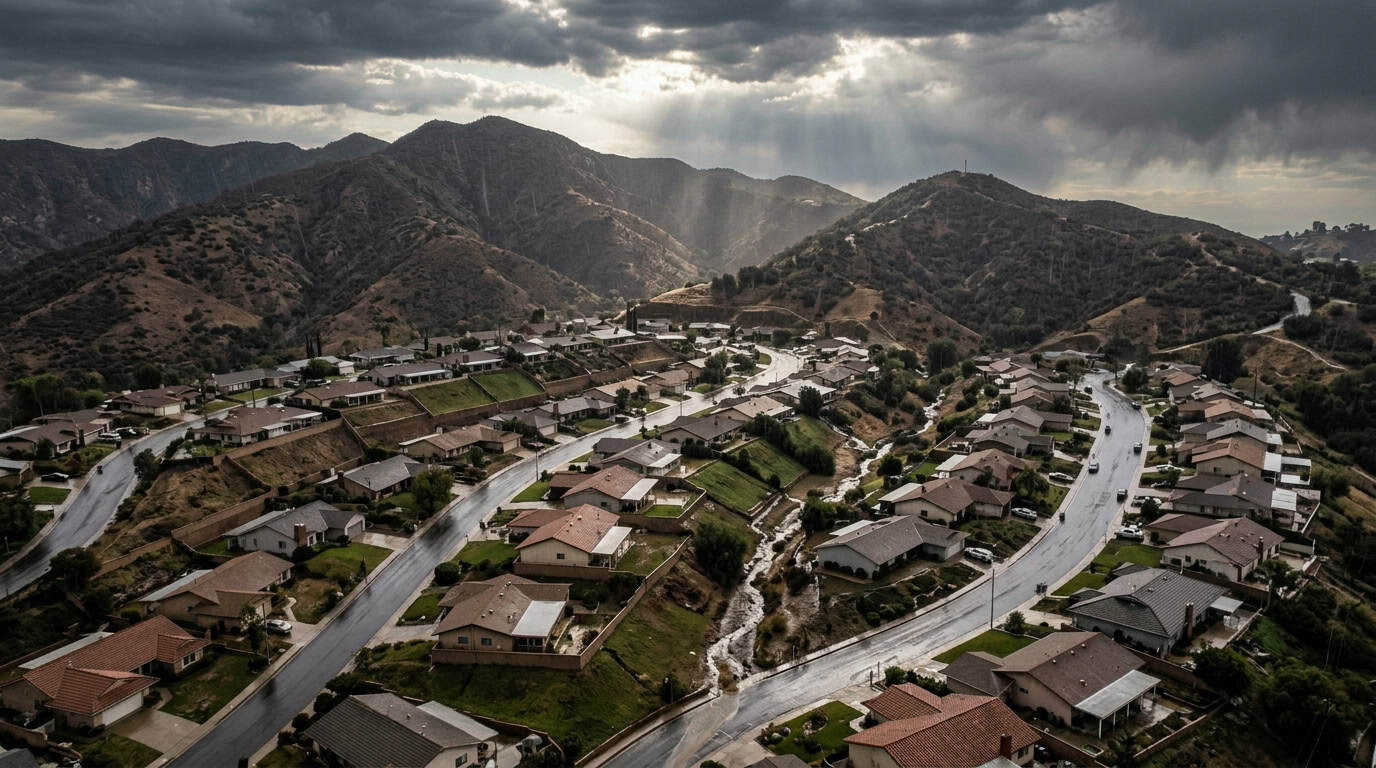
Foundation Repair — Thousand Oaks, CA
FOUNDATION REPAIR IN THOUSAND OAKS — EXPERT STRUCTURAL SOLUTIONS FOR CONEJO VALLEY HOMES.
Thousand Oaks foundation repair is what we do. Foundation problems are like a toothache — the longer you wait, the more they cost. To date, Bristolfx has repaired over 40 foundations across the Conejo Valley. Our team knows exactly what the soil here does to your home. The fix is permanent.
GET A FREE INSPECTION
CALL (661) 294-1313
✓ AZ ROC #354312
✓ Brace + Bolt Certified
✓ 20+ Years Local
✓ Lifetime Warranty
✓ Free Inspections
Why Thousand Oaks Is Different
Thousand Oaks Was Built Fast, On Difficult Ground. The Median Home Is Now Nearly 50 Years Old — And The Ground It Sits On Has Been Moving The Entire Time.
Thousand Oaks grew up almost overnight. Most of its housing stock was built between the 1960s and 1990s — a period of aggressive hillside grading. Developers cut into the uphill side of slopes and used that soil to fill the downhill side, creating flat building pads on terrain that was never meant to be flat. Specifically, the median construction year is 1978. That foundation has already endured nearly 50 wet seasons, 50 dry seasons, and 50 annual cycles of expanding and shrinking clay soil.
In addition, below every Thousand Oaks neighborhood runs expansive Conejo Valley clay, loosely consolidated Saugus Formation sandstone, and alluvial deposits from the Santa Monica Mountains. Furthermore, the Woolsey Fire stripped slopes bare in 2018. The average annual rainfall of 15 inches — mostly in intense bursts — saturates clay soil that can expand with up to 15,000 lbs of upward pressure. The Oak Ridge Fault runs directly through Ventura County.
“Most foundation companies send a salesperson. Bristolfx sends a qualified inspector — a trained specialist who evaluates the root cause and delivers a written solution, not a sales pitch.”
1978
Median year built — now entering peak foundation failure age
1,558
Gallons shed by your roof in a single 1-inch rain event
99%
Of Thousand Oaks properties at wildfire risk — post-fire runoff hits foundations hardest
40+
Bristolfx foundation repairs completed in Thousand Oaks
The Conejo Valley Triple Threat
Thousand Oaks Foundations Don’t Fail Because Of Bad Luck. They Fail Because Of Three Specific Forces Working At The Same Time.
Every one of these forces is active on your property right now. However, most contractors identify only one. By contrast, we identify all three — and address the cause, not just the symptom.
Force #1
The Double-Whammy Rain Effect
First, your roof is a 2,500 sq ft funnel. In a single 1-inch rain event it sheds 1,558 gallons — concentrated right against your foundation. As a result, saturated Conejo clay expands with up to 15,000 lbs of upward pressure, physically bending concrete. Then, when it dries in summer, it contracts and pulls away, leaving voids the foundation drops into. In short, every wet-dry cycle ratchets the damage further.
Force #2
Biological Moisture Mining
Thousand Oaks is named for its oaks — and they are thirsty. Specifically, during dry months, roots from mature Valley Oaks and Sycamores travel horizontally under your house, drawn to the moisture preserved by your slab. In fact, a mature oak can extract up to 200 gallons of water per day from beneath your footings. We have removed Sycamore roots from beneath living room slabs in Thousand Oaks. The photos are on this page.
Force #3
The Conejo Ratchet Effect
Thousand Oaks clay doesn’t just expand and shrink symmetrically — it ratchets. For example, every time the soil shrinks in summer, debris fills the gaps. When it rains again, that debris prevents the structure from settling back to level. Consequently, each year adds another increment of displacement. After 30 or 40 cycles, your home has been walked progressively further out of alignment — and no amount of surface patching will reverse it.
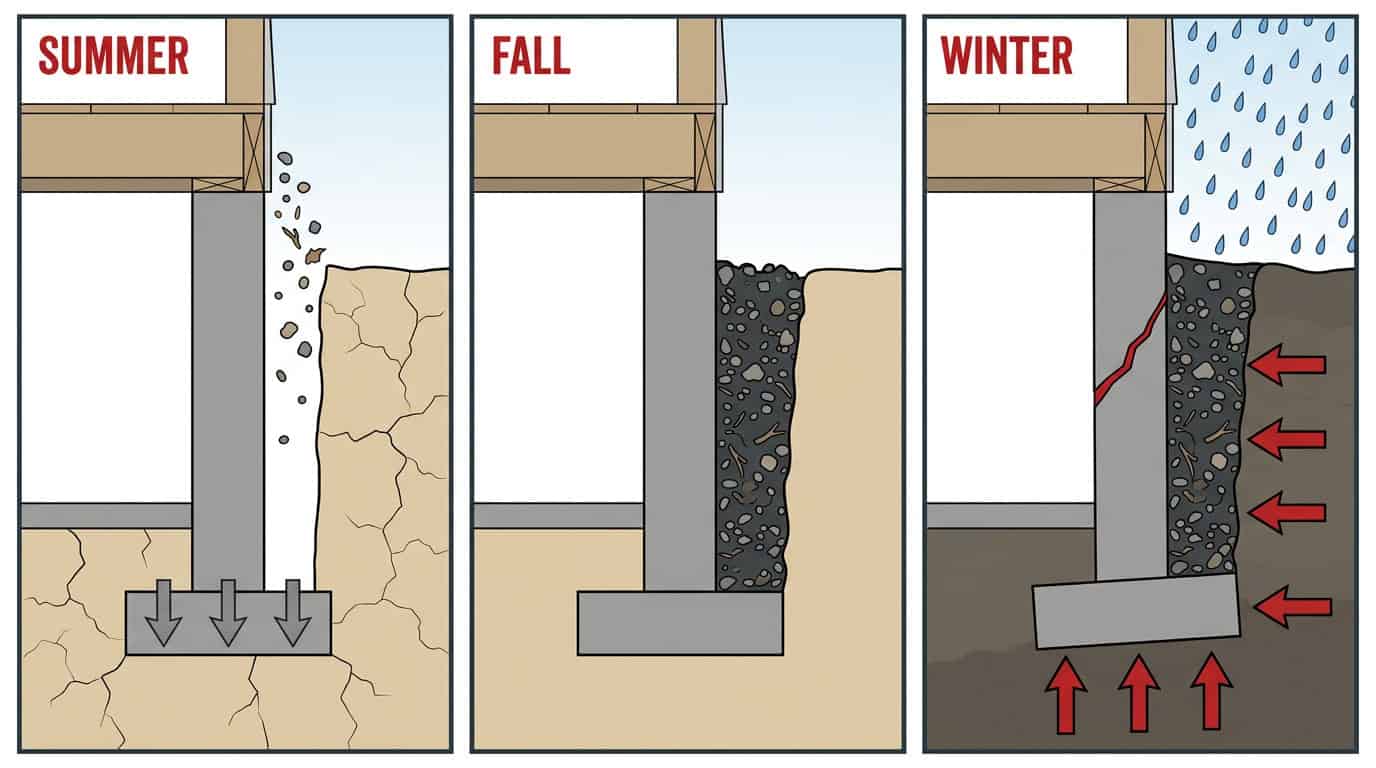
The Conejo Ratchet Effect — Summer gap opens, Fall debris fills, Winter clay can’t push the foundation back. Your home shifts further out of alignment every year.

Dry Conejo Valley clay in summer. These cracks open beside your footing every year and fill with debris before winter rains arrive.
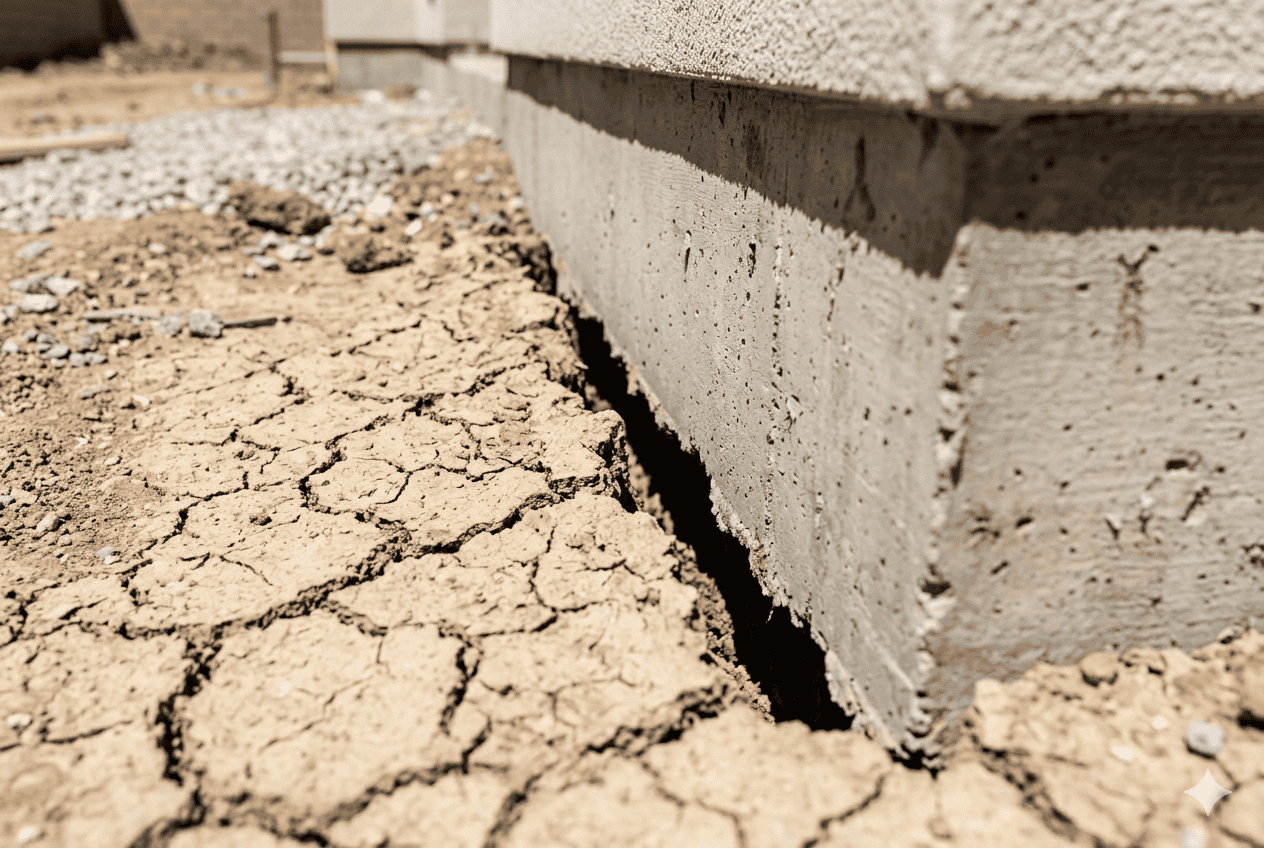
The gap between footing and clay. Debris fills this every fall — blocking the foundation from returning to level when the clay expands again.
The Hidden Problem Under Every Hillside Home
Half Your Lot Was Built. The Other Half Was Carved. They Don’t Move The Same.
To create flat building pads on Conejo Valley hillsides, developers cut into the uphill slope and used that material to fill the downhill side. On one hand, the cut side sits on stable native soil. Meanwhile, the fill side — which can be 10 to 20 feet deep on steeper lots — continues settling under the weight of your home for decades. In other words, that difference is called differential settlement, and it is the most common cause of foundation damage in this city. We verify it with a Ziplevel Pro-2000 that measures settlement to 1/100th of an inch.
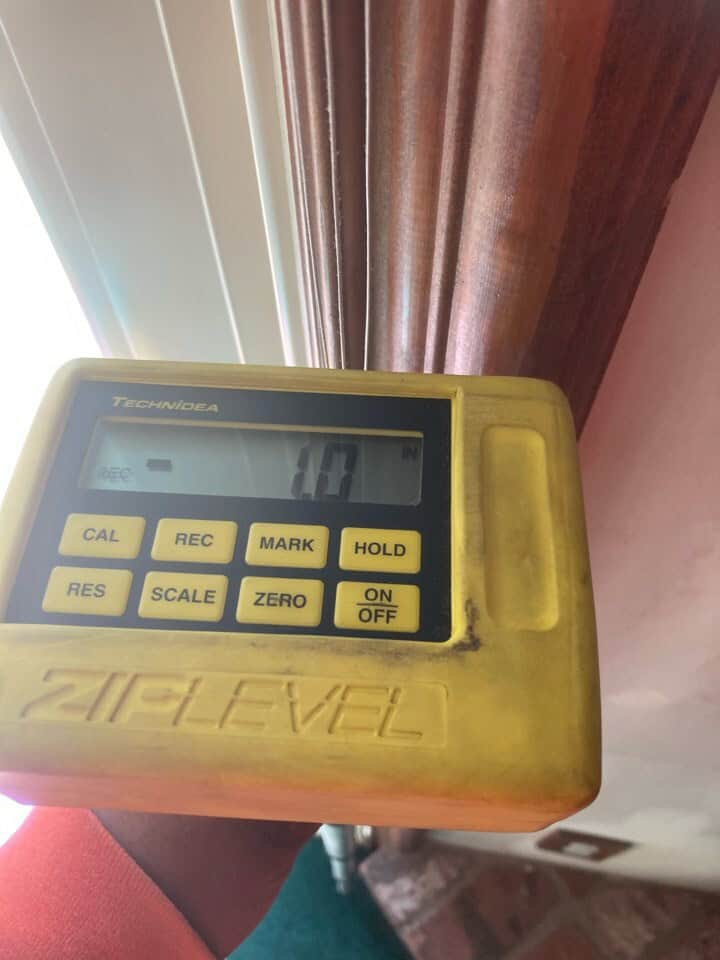
Ziplevel Pro-2000 measuring differential settlement to 1/100th of an inch. We document exactly how far each footing has moved before proposing any repair.
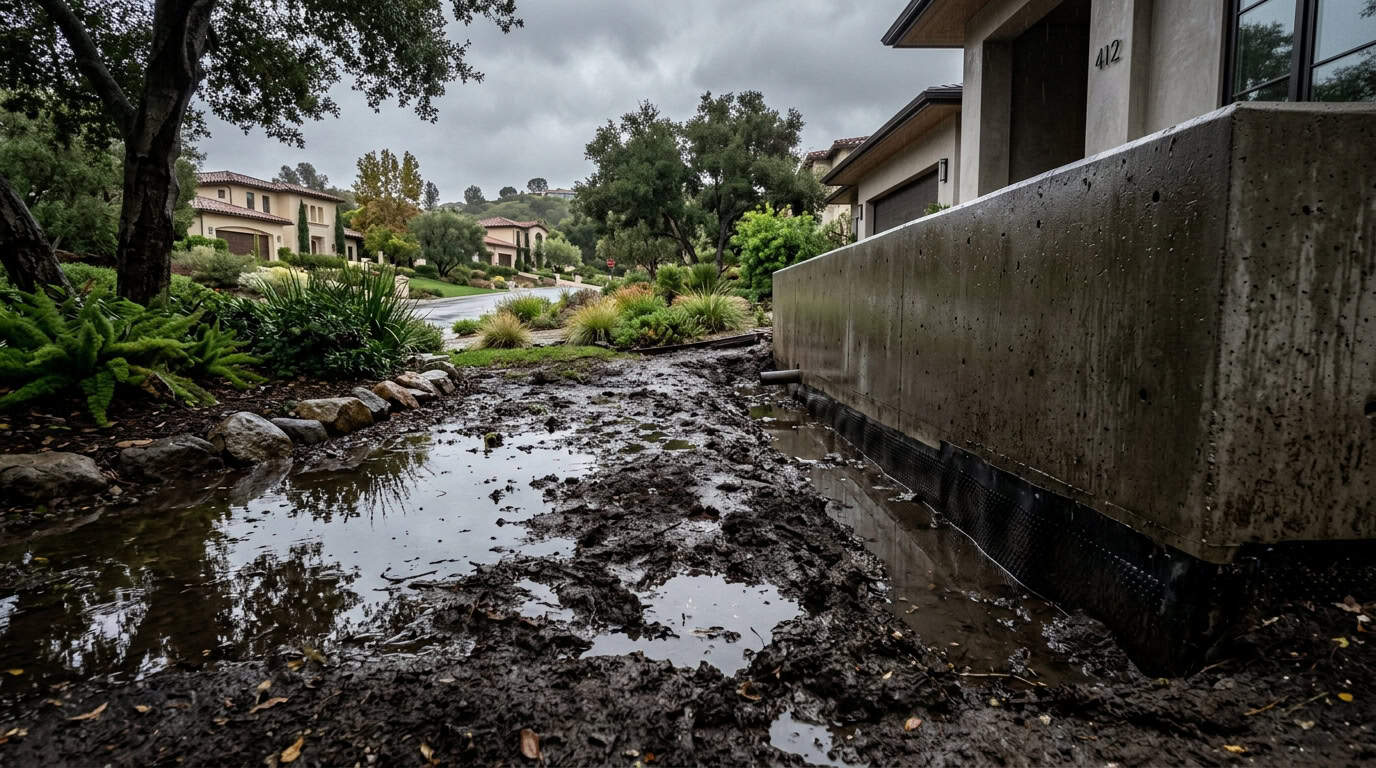
Saturated soil pooling against a Conejo Valley foundation after rain. This volume triggers the clay expansion cycle — 15,000 lbs of upward pressure against your footing.
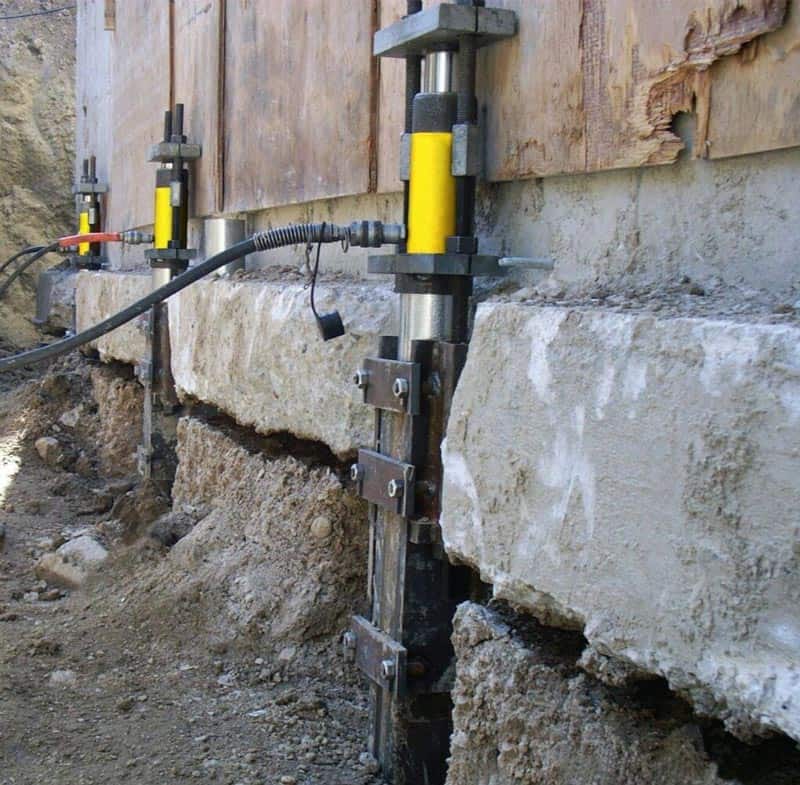
Piers installed with lift cylinders — 3 inches of lift on the fill side. The foundation is back to level for the first time in decades.
Real Job — Thousand Oaks, CA
We Removed A Sycamore Root From Beneath A Thousand Oaks Living Room Floor. This Is What It Looks Like.
Biological moisture mining is not a theoretical risk in Thousand Oaks — it is one of the most common causes of slab movement we encounter. For instance, mature Sycamores and Valley Oaks extend root systems far beyond their canopy drip lines. Specifically, under a slab, roots find and follow the moisture gradient, growing until they physically lift and fracture the concrete above them. Below, the photos document an actual Bristolfx job in Thousand Oaks.
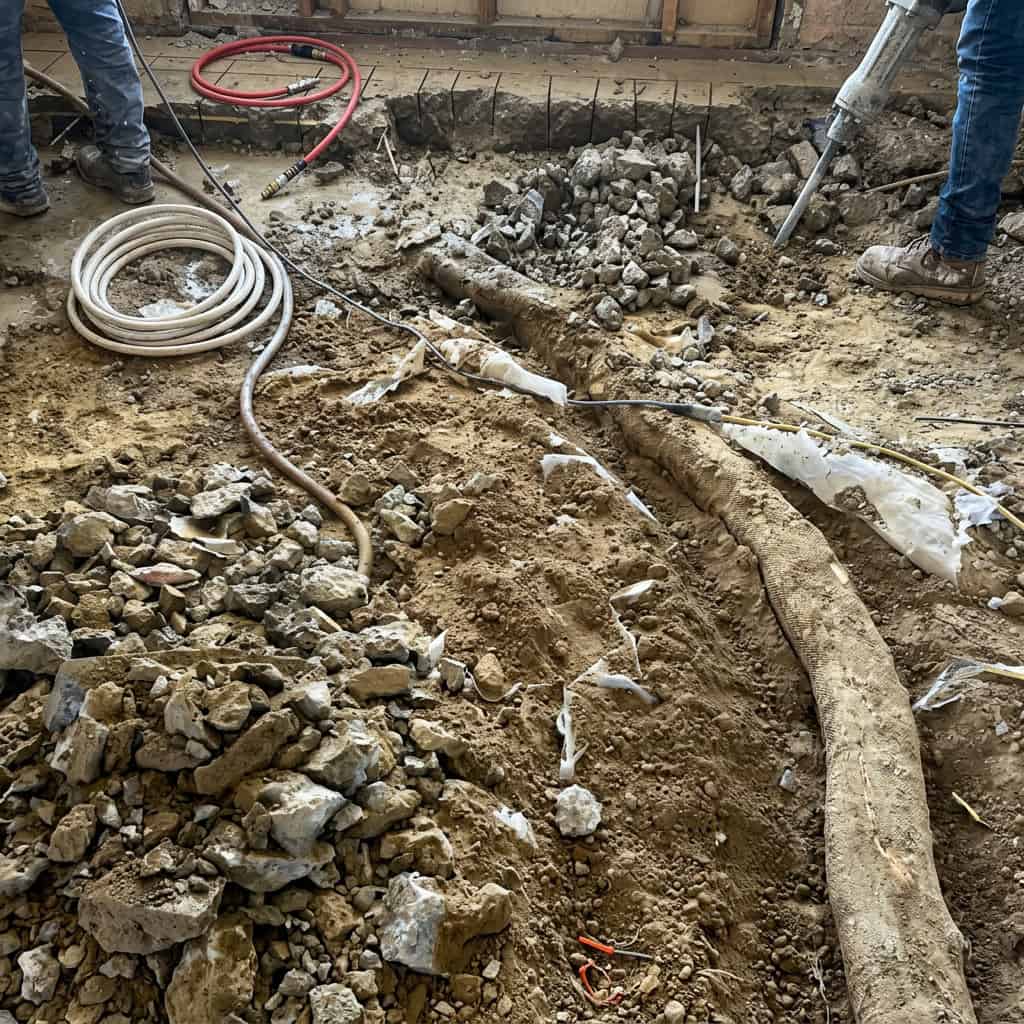
The Sycamore root removed from beneath the living room slab. The homeowner first noticed cracking floors — by the time we arrived, the root had been growing under the concrete for years.
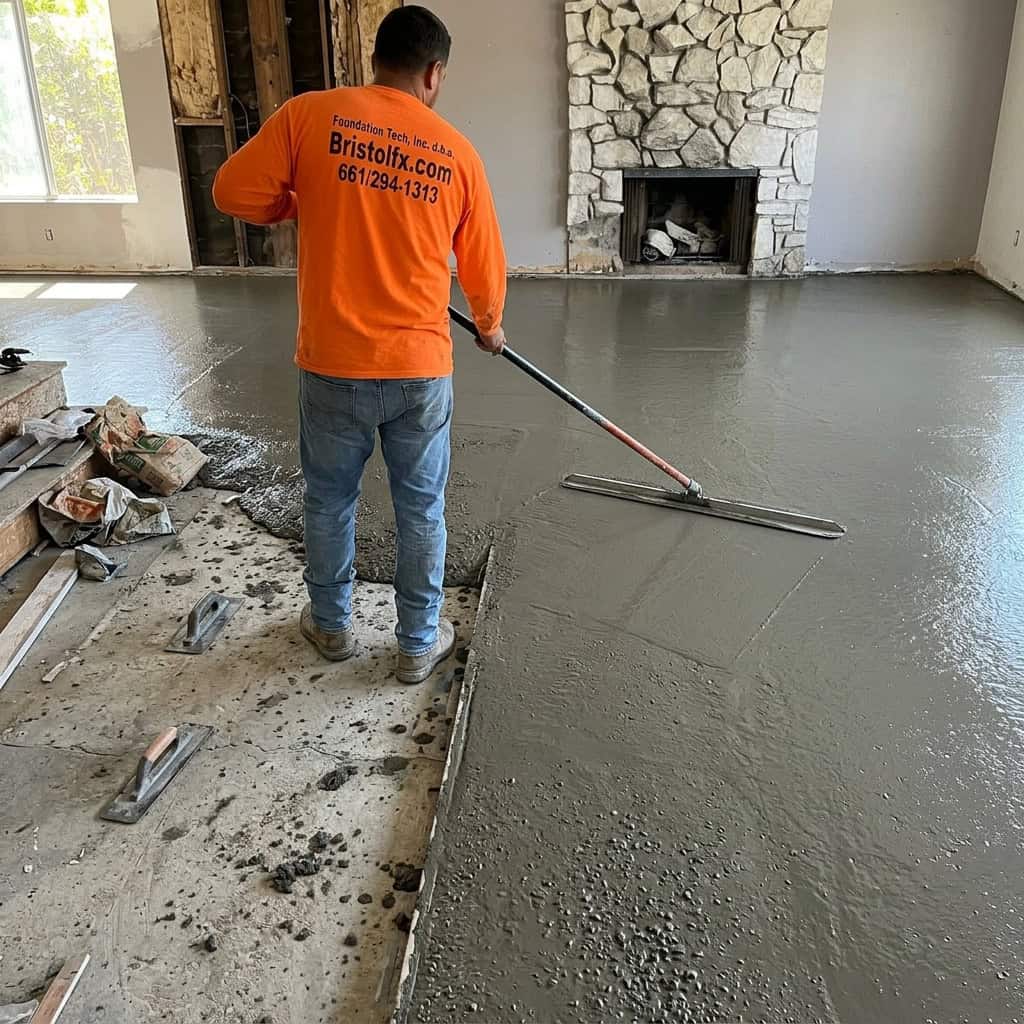
New slab poured and finished after root removal. Same living room — completely restored. This is what a finished Bristolfx job looks like.
If You Have Mature Trees Within 30 Feet Of Your Foundation:
A free Bristolfx inspection includes root exposure assessment. We evaluate whether tree roots are contributing to soil moisture loss, slab heave, or stem wall pressure — before any work is proposed. No cost. No obligation.
What This Means For Your Home
Most Thousand Oaks Homes Have Two Or Three Of These Forces Active At Once. Most Contractors Only Check For One.
When Bristolfx inspects a Thousand Oaks property we evaluate the grading history of the lot, fill depth at every footing, soil type, tree proximity and root exposure, post-fire drainage conditions, and the seismic exposure of the structure. You get a complete diagnosis — not just the crack on the wall that made you call us.
Two More Threats Specific To This City
The Woolsey Fire Changed The Hillsides. The Oak Ridge Fault Has Not Moved Yet. Neither One Is Done With Thousand Oaks.
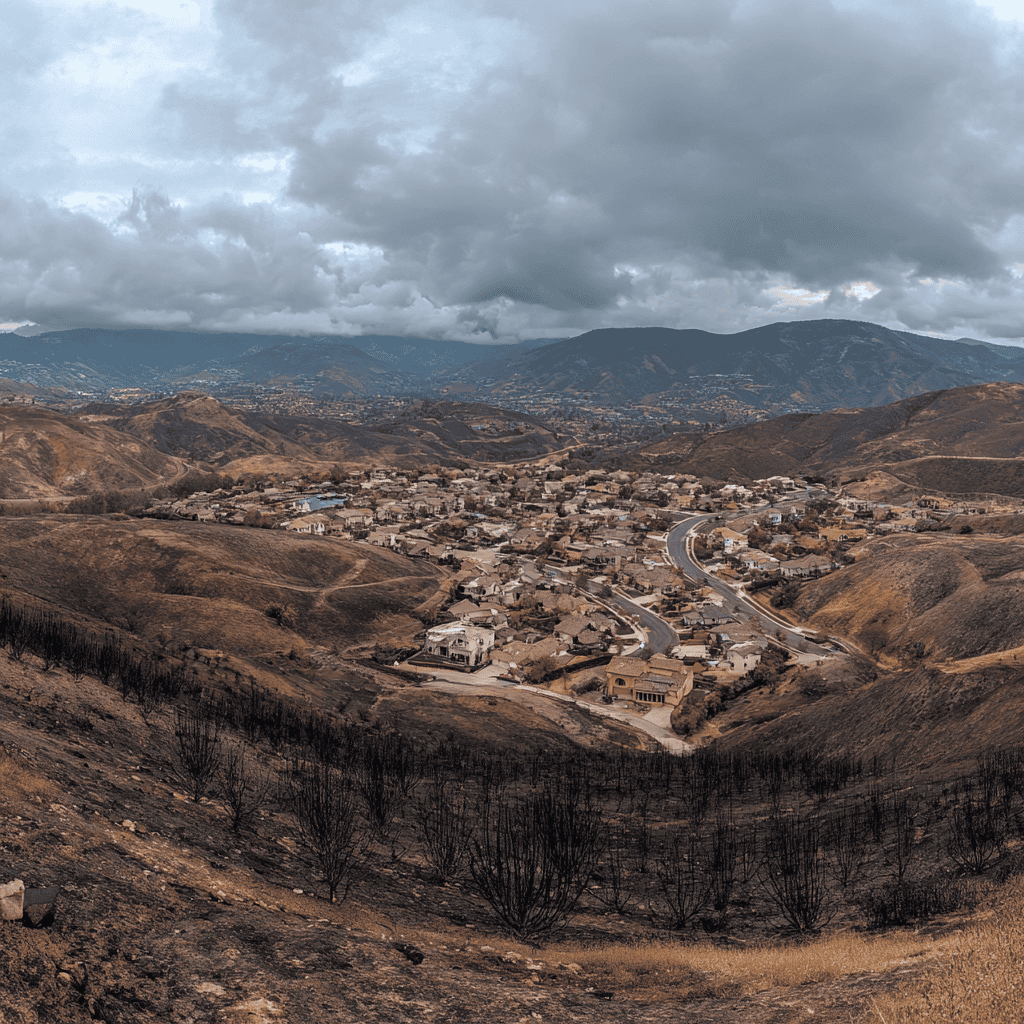
Burned Thousand Oaks hillsides above residential neighborhoods after the Woolsey Fire. Bare hydrophobic slopes now shed 10x the normal water volume toward the foundations below during every rain event.
Know The Warning Signs
These Are The Symptoms Thousand Oaks Homeowners Call Us About Most Often.
Foundation problems rarely announce themselves dramatically. Instead, they show up as small annoyances that gradually get worse. Therefore, if you are seeing any of these, do not wait.
| Warning Sign | What It Means In Thousand Oaks | Urgency |
|---|---|---|
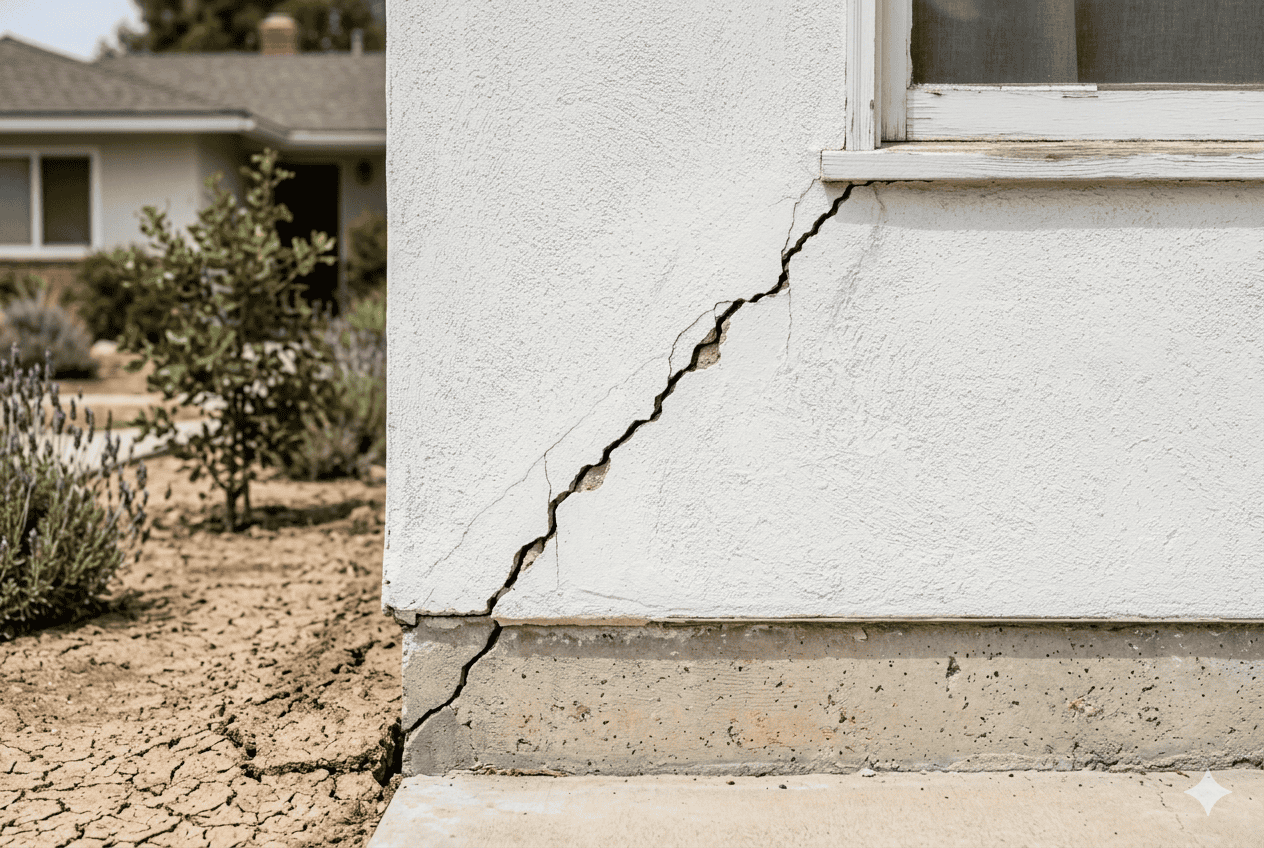
| Diagonal stair-step cracks in stucco | Foundation has moved. Do not re-stucco — call us first. | High |
| Doors stick in summer, loosen in winter | Clay cycle actively moving the frame. A clear ratchet indicator. | High |
| Floors sloping toward the downhill side | Fill-side differential settlement. Classic cut-and-fill signature. | High |
| Slab cracking near interior doorways | May indicate tree root intrusion, clay heave, or both. | High |
| Springy or sagging floors | Failed post or beam in crawlspace. Wood rot accelerates quickly. | High |
| Retaining wall tilting or cracking | Soil load increased — often from post-fire runoff. Direct foundation threat. | Urgent |
| Standing water near foundation after rain | Drainage failure actively saturating soil. Source of the ratchet effect. | Moderate |
The Bristolfx Solution Suite
We Don’t Patch Cracks. We Engineer Permanent Exits From The Cycle Of Failure.
Every Bristolfx repair addresses the root cause. Here is what we use in Thousand Oaks — and why each solution fits the specific conditions of the Conejo Valley.
| Service | Why It Works In Thousand Oaks |
|---|---|
| Push & Helical Piers | We anchor your foundation to bedrock below the active Conejo clay zone — bypassing the fill and expansive soil entirely. Lifetime transferable warranty. The permanent solution for hillside differential settlement. |
| Crawlspace Repair | Post and beam repair, floor joist sistering, stem wall repair for Thousand Oaks older pier-and-beam homes. All materials rated for the actual moisture and soil conditions of your site. |
| Seismic Retrofit — Brace + Bolt | Certified cripple wall bracing for pre-1980 Thousand Oaks homes against the Oak Ridge Fault. Permitted through the City of Thousand Oaks Building Division. Every time. |
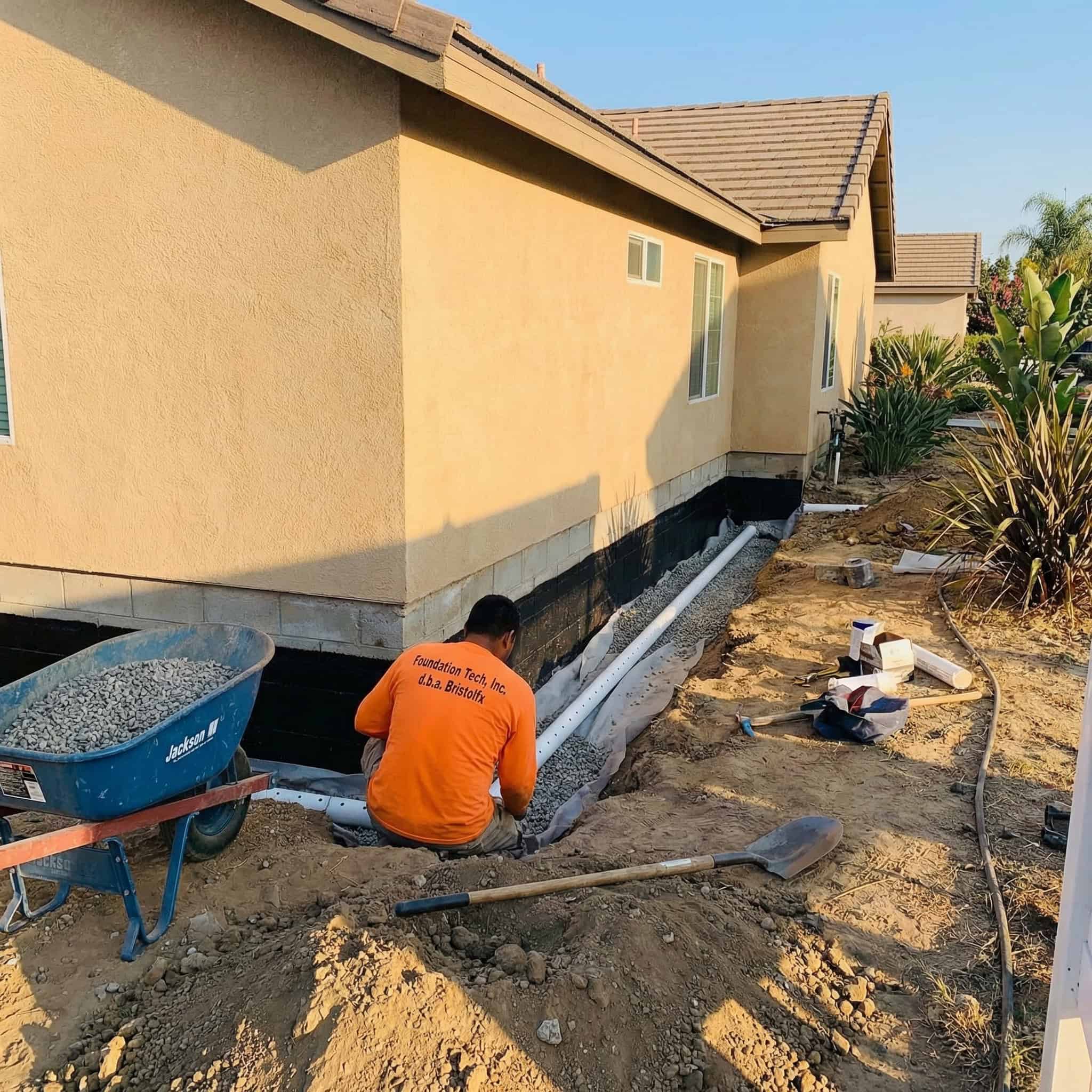
| Engineered Drainage | French drains and drainage systems that intercept the 1,558+ gallons your roof sheds per rain event — away from your footings. Solving the water problem is the essential first step before structural repair. |
| Tie-Backs & Hillside Creep | For canyon and hillside homes where the slope is moving, engineered tie-backs anchor the structure to stable ground above. Essential for Thousand Oaks canyon lots where the hill itself is the threat. |
| Retaining Wall Repair | Repair and rebuilding of failing hillside retaining walls before they transfer their load to your foundation. Permitted, engineered, built for post-Woolsey runoff conditions. |
| Water Management & Mitigation | In Thousand Oaks most homes are slab-on-grade or crawlspace — not basements. The water problem here is intrusion: water penetrating cold joints between the slab and stem wall, patio slabs that slope toward the house driving moisture above the sill plate, and crawlspace ground moisture from hillside runoff. We stop water at the source — cold joint polyurethane injection, patio slab regrading, crawlspace vapor barriers, and French drain installation. |
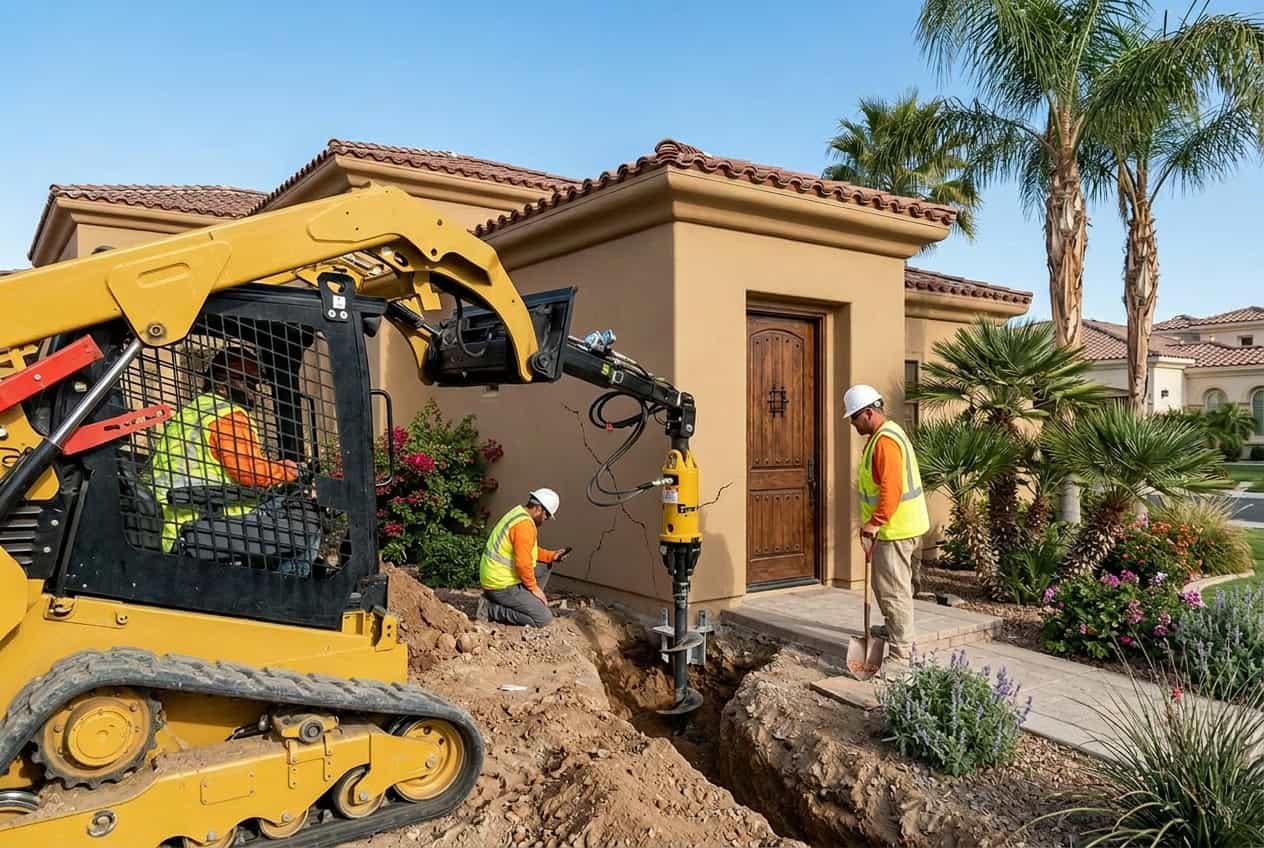
Helical pier installation beside a Thousand Oaks foundation. The pier screws through unstable fill and Conejo clay to bedrock — permanently bypassing everything that moves.
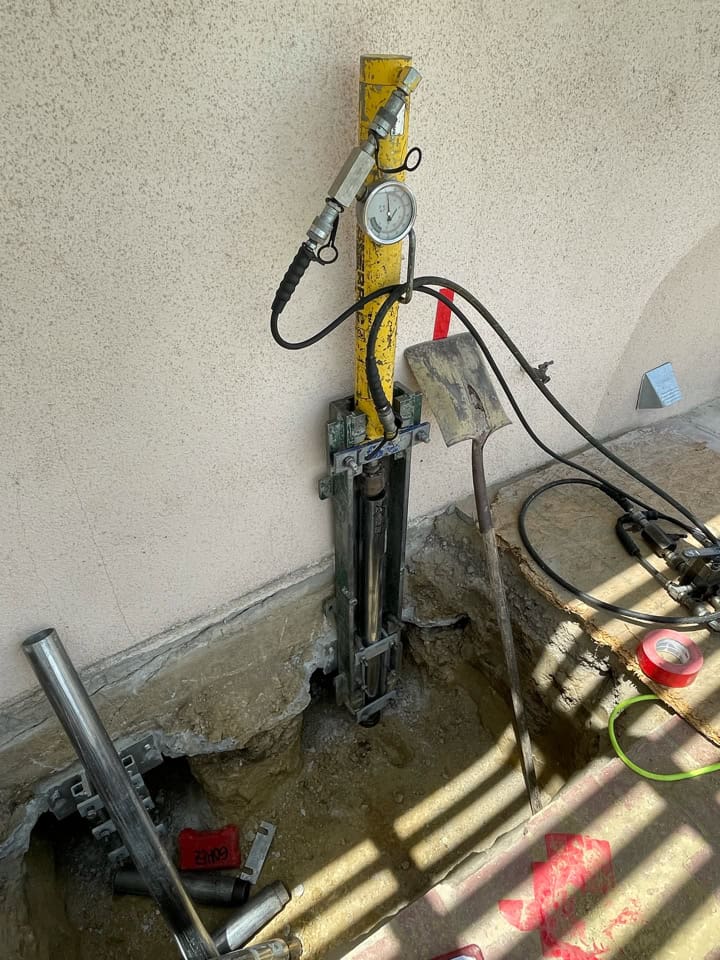
ECP 300 push pier drive stand mounted to a slab foundation. The pier is hydraulically driven through this bracket to load-bearing soil — then the foundation lifts.
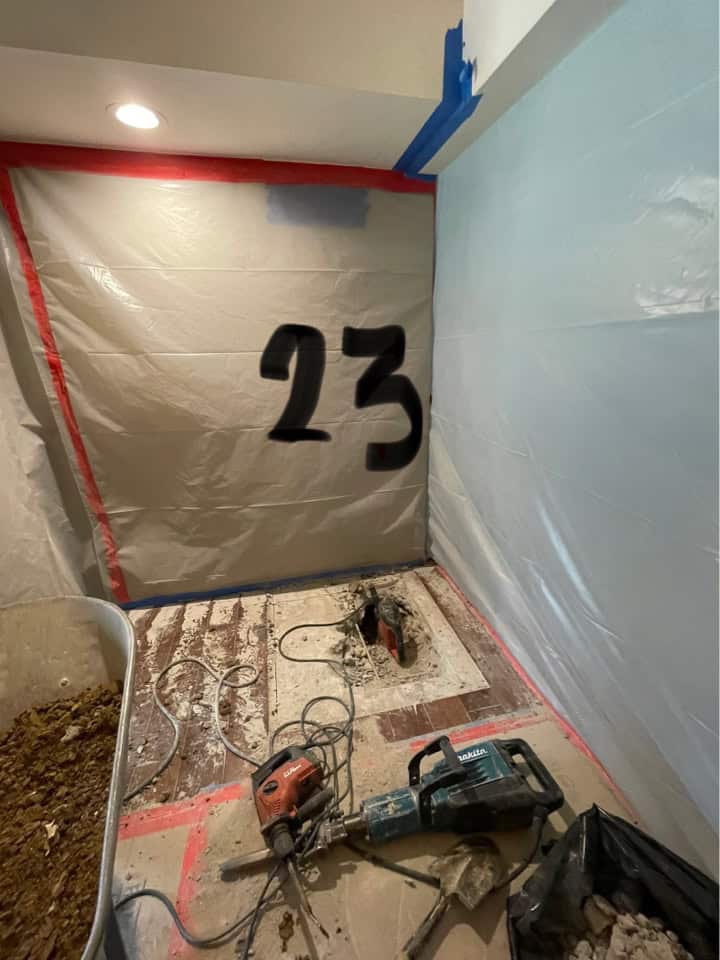
Interior pier prep — precise access cuts through the slab to reach the footing. Minimal footprint. Fully restored after installation.
Water Management & Mitigation
Most Thousand Oaks Homes Don’t Have A Waterproofing Problem. They Have A Water Management Problem. There’s A Difference.
In Thousand Oaks, most homes are slab-on-grade or crawlspace construction — there are no basements to flood. Instead, the water threat here is more specific: water finding its way in at the points where your home is structurally most vulnerable. We have seen this pattern repeat on dozens of Thousand Oaks properties and it is almost always one of three problems.
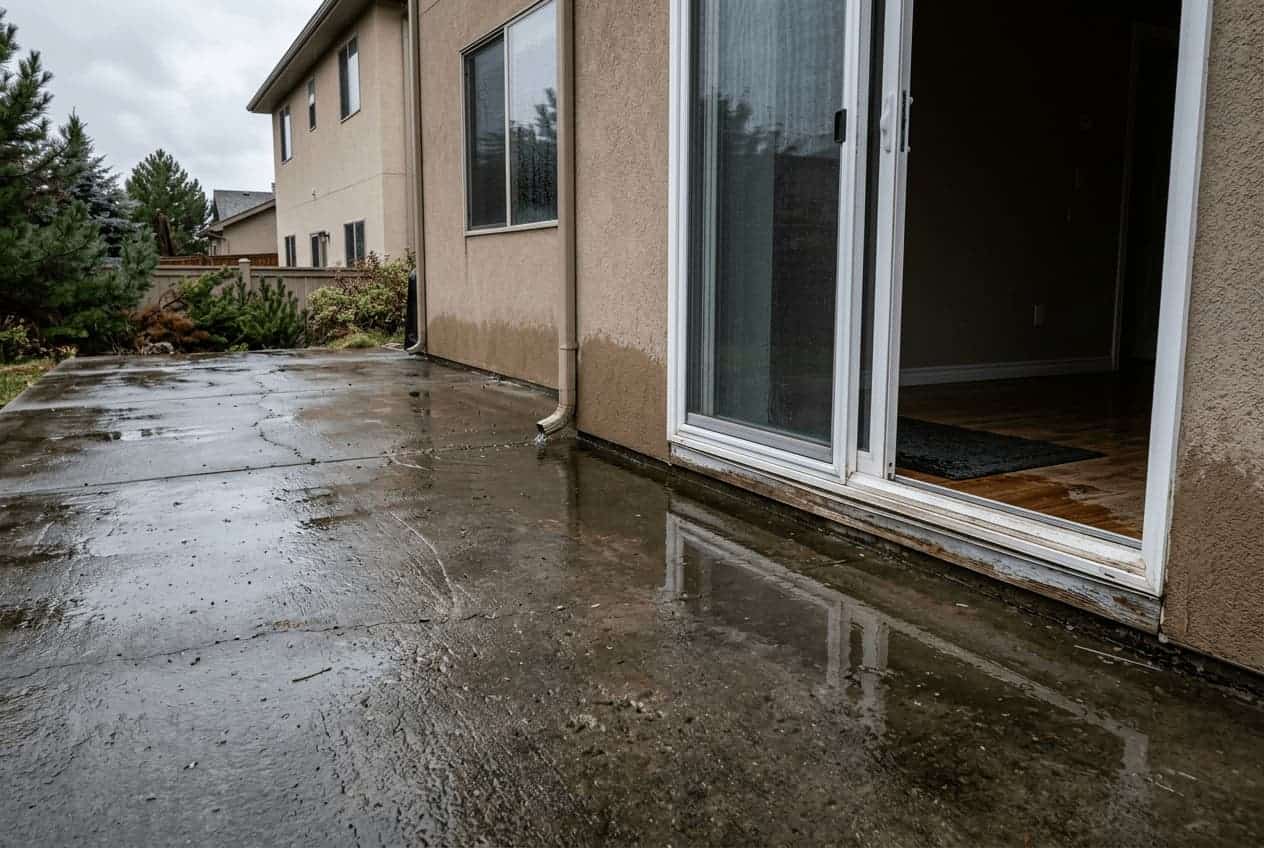
A patio slab settled toward the house over 40 years. Every rainstorm now drives water directly at the stucco wall and under the door threshold — above the sill plate.
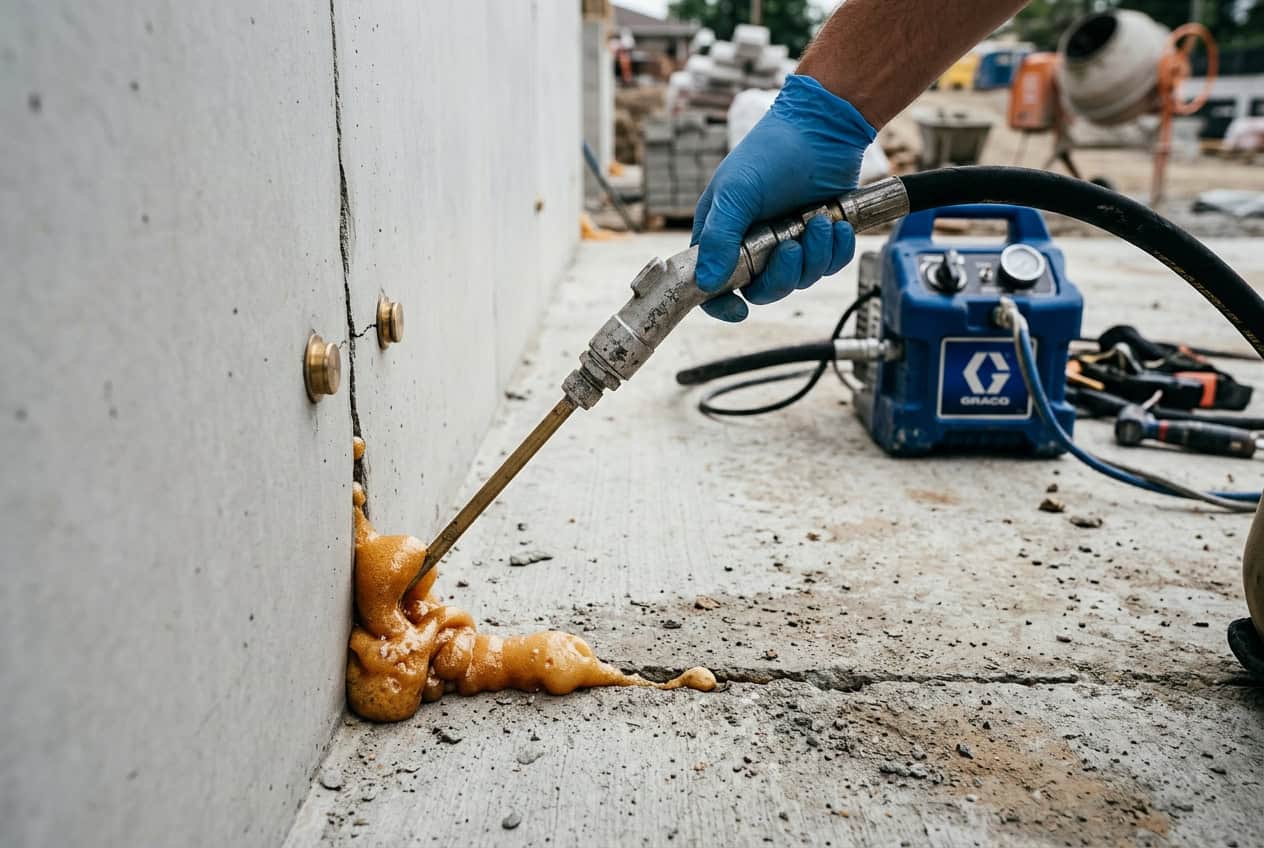
Polyurethane foam injected into metal ports at a cold joint. The flexible seal expands to fill the void and moves with the joint — permanently stopping intrusion at the source.
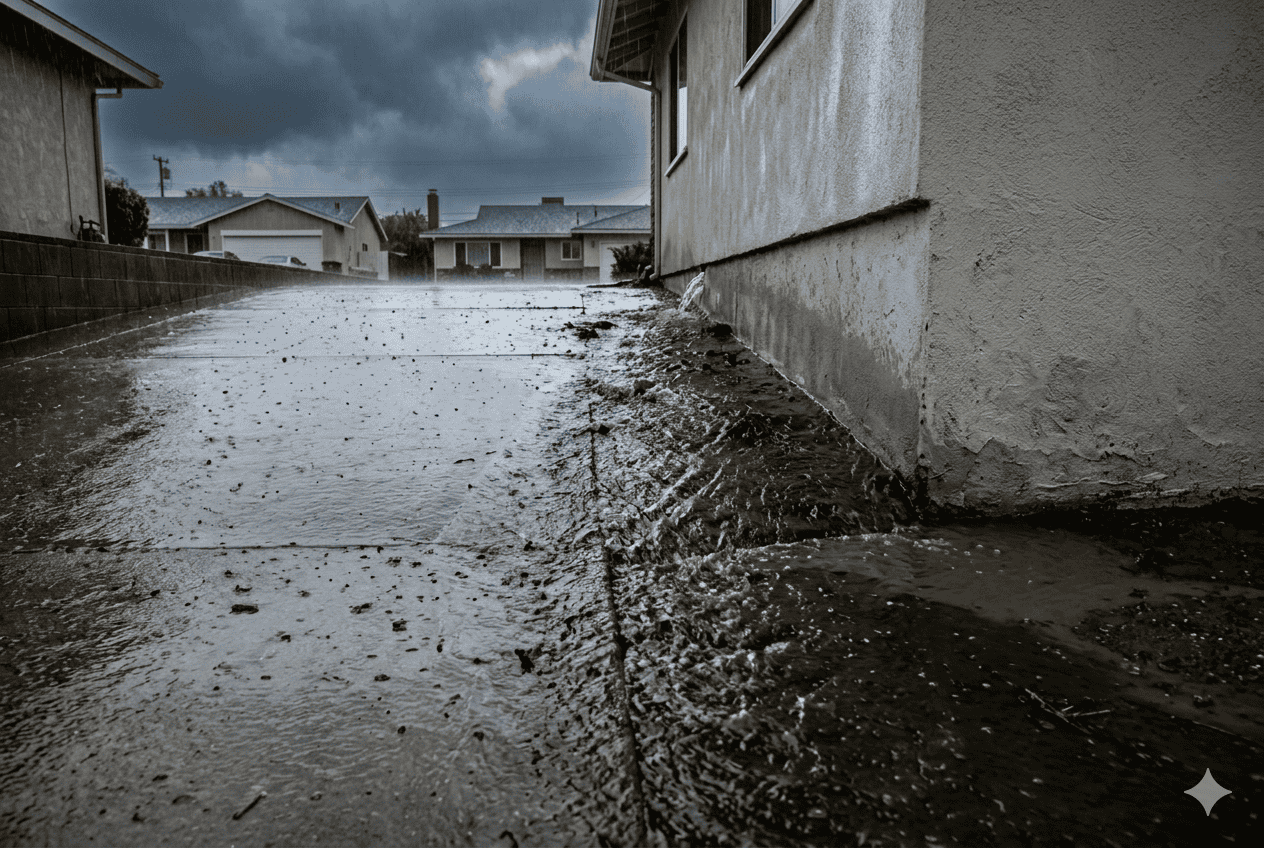
Storm water rushing toward a foundation. This is the volume — 1,558 gallons per inch of rain — that saturates clay soil and triggers the ratchet effect every winter.
Signs You Have A Water Management Problem:
✓ Musty odor in rooms adjacent to slab edge
✓ Baseboard swelling or paint bubbling at floor level
✓ Patio door threshold showing rust or rot
✓ Wet spot on interior floor after heavy rain
✓ Crawlspace smells after winter rains
Why Bristolfx
There Are Other Foundation Contractors In Thousand Oaks. Here Is Why Conejo Valley Homeowners Choose Us Over The National Brands.
National foundation repair companies buy visibility with display ad spend. In other words, they generate leads and hand them to franchise operators in markets they have never worked in. By contrast, Bristolfx is different: the person who inspects your property has spent 20 years repairing foundations in this exact market. We know what cut-and-fill differential settlement looks like in Lang Ranch. Just as importantly, we recognize what Conejo clay does to a 1972 slab in Lynn Ranch. Therefore, a national template does not know any of that.
20+
Years In Business
Foundation Tech, Inc. has been repairing foundations across Southern California since 2004. We have seen what the Conejo Valley does to homes over decades — not just years.
40+
Jobs In Thousand Oaks
Lynn Ranch. Lang Ranch. Newbury Park. Wildwood. We are not learning your soil conditions on your dime. By now, we already know them — and we have the job site photos to prove it.
$0
Cost For Your Inspection
Our inspections are free. Not “free if you sign” — actually free, with zero obligation. We get under your house, document everything with photos, and explain your options in plain language.
Licensed Owner Involvement
Foundation Tech, Inc. is a licensed California and Arizona contractor — not a franchise. CA CSLB #991221. Furthermore, the licensed contractor is directly involved in every job. You are not handed off to a subcontractor you cannot hold accountable.
Lifetime Transferable Warranty
Our pier repairs carry a lifetime warranty that transfers to the next owner — adding real documented resale value. When you sell, buyers see a foundation permanently warranted by a licensed contractor, not a disclosure problem.
Everything In Writing — Always
Every repair, every material, and every cost is in writing before you agree to anything. Additionally, any scope change requires a written change order signed by you first. As a result, there are no surprises on the invoice — without exception.
How It Works
Our 5-Step Process — No Surprises, Ever.
Every Bristolfx job follows the same disciplined process. There are no verbal estimates, and no guesswork.
Free Inspection — We Assess The Full Picture
We evaluate the grading history of your lot, fill depth at footings, soil type, crawlspace condition, drainage, post-fire exposure, tree root proximity, and seismic risk. Everything is documented with photos. There is no cost, and no obligation.
Detailed Written Proposal
Every repair, every material, every cost — in writing before you agree to anything. Pricing is clearly fixed. There are no verbal estimates, and no surprise charges.
Proposal Walk-Through — You Sign Only When Ready
We walk through every line with you. Importantly, nothing starts until you are completely comfortable and have signed. Our team provides the data. You make the decision.
Permits Through The City Of Thousand Oaks
We handle every permit application, inspection, and code compliance requirement through the Thousand Oaks Building Division. As a result, you make zero calls to the city.
The Work — On Schedule, Photographed At Every Stage
Our crew arrives on the day we commit to. We photograph every stage. Furthermore, any scope change requires a written change order signed by you first — without exception.
Thousand Oaks Foundation Repair FAQs
Questions Thousand Oaks Homeowners Ask Us Most Often.
Straight answers — no jargon, no sales language. If your question isn’t here, call (661) 294-1313.
How much does foundation repair cost in Thousand Oaks?
Foundation repair costs in Thousand Oaks typically range from $5,000 to $30,000 depending on repair type, number of piers, and severity of settlement. For example, minor crawlspace repairs may cost $3,000–$8,000. In contrast, full pier installations for a hillside home average $12,000–$25,000. We provide a complete written fixed-price proposal after a free inspection — no verbal estimates, no surprise charges.
What causes foundation problems in Thousand Oaks specifically?
Thousand Oaks foundations fail for three primary reasons: cut-and-fill differential settlement on hillside lots, expansive Conejo Valley clay that expands up to 15,000 lbs of pressure in winter and contracts in summer, and biological moisture mining by mature Sycamore and Valley Oak tree roots growing beneath slabs. The average annual rainfall of 15 inches — mostly in intense bursts — accelerates all three.
Can you explain the Conejo Ratchet Effect?
The Conejo Ratchet Effect describes how Thousand Oaks clay soil moves your foundation in one direction over time. First, each summer the clay shrinks and pulls away from the footing, creating a gap. Then, debris fills the gap in fall. Finally, when winter rains arrive, the expanding clay cannot push the footing back because the debris blocks it. Over time, your home is ratcheted a little further out of alignment. To stop the cycle, the foundation must be anchored below the active clay zone.
Why does cut-and-fill grading matter for my Thousand Oaks home?
Cut-and-fill is the grading technique used to build flat pads on Thousand Oaks hillsides. The uphill side was cut into native soil and the material used to fill the downhill side. However, these two sides settle at completely different rates — the fill side continues moving for decades while the cut side stays stable. Importantly, this differential settlement produces cracked walls, sloping floors, and sticking doors.
I have water coming in at the base of my wall after rain — is that a foundation problem?
In Thousand Oaks this is almost always a water management problem rather than structural failure — but left untreated it becomes both. The most common causes are a cold joint opening between your slab and stem wall, a patio slab that has settled toward the house driving water above your sill plate, or inadequate perimeter drainage. Therefore, we diagnose the source during your free inspection and seal it at the cause — not at the symptom.
How long does foundation repair take in Thousand Oaks?
Most Thousand Oaks pier installations take 2–4 days. Similarly, crawlspace repairs typically take 1–3 days. Seismic retrofits average 1–2 days. All work is permitted through the City of Thousand Oaks Building Division — we handle the entire permit process. A specific timeline is in your written proposal before any work begins.
Does foundation repair affect my home’s resale value?
Yes — positively, when done correctly. An undisclosed foundation problem is a liability at sale. In contrast, a properly permitted repair with a lifetime transferable warranty from a licensed contractor is a documented asset. Specifically, Bristolfx provides a lifetime transferable warranty on push and helical pier installations.
My Thousand Oaks home was built in the 1970s — do I need a seismic retrofit?
If your home was built before 1980 and has a raised foundation it almost certainly has an unbraced cripple wall — the first structural element to fail in a lateral seismic event. The Oak Ridge Fault runs directly through Ventura County. Bristolfx is Brace + Bolt certified and performs seismic retrofits on Thousand Oaks homes throughout the Conejo Valley, permitted through the City of Thousand Oaks.
Explore More
Foundation Repair Across The Conejo Valley & Surrounding Areas
Bristolfx serves homeowners throughout Thousand Oaks and the surrounding region. Our nearby coverage includes Moorpark, Northridge, Brentwood, and Burbank. Explore specific services we use here: push and helical piers, crawl space repair, and drainage solutions. View our full coverage map across Southern California, Southern Nevada, and Arizona, or contact us for a free Thousand Oaks foundation inspection.
What Homeowners Say
Real Results. Real Homeowners.
“Nathan, Calen and Anthony communicated with me throughout the entire process. I could not close my front door before the repair. After the lift, my door closes easily. My house is now strong and stable. Worth every penny.”
Joanne C.
Homeowner — Los Angeles, CA · Yelp Review
“Jerry showed up on time and patiently listened to all my concerns. He was honest — the tips he gave me wouldn’t even benefit his company. He is one of the good guys. I wholeheartedly recommend Foundation Technology.”
Amber L.
Homeowner — Lancaster, CA · Yelp Review
“I was very satisfied with the repair process and the entire job only took four days! I couldn’t imagine using another company and can’t thank Bristolfx enough for making such a stressful situation bearable.”
Stephanie D.
Homeowner — Santa Clarita, CA · Google Review
Thousand Oaks — Free Inspection
The Clay Isn’t Stopping. The Fill Isn’t Done Settling. The Oak Ridge Fault Hasn’t Moved Yet. Your Foundation Repair Should Start Now.
In short, a free Bristolfx inspection costs you nothing and commits you to nothing. Specifically, we assess your lot grading, soil conditions, crawlspace, drainage, tree root exposure, and seismic exposure — document everything with photos — and explain your options in plain language before you make any decision.
Zero Pressure. Written Proposal. Root-Cause Analysis.
✓ We provide the data — you make the decision
✓ Clear fixed pricing — no surprises on the invoice
✓ We tell you why it happened so it never happens again
▶ Foundation Repairs Suck — How We Make Them Better
📞 CA: (661) 294-1313
Foundation Tech, Inc. d.b.a. Bristolfx | CA CSLB #991221 | Licensed & Insured | Brace + Bolt Certified | Serving Thousand Oaks, Newbury Park, Westlake Village, Agoura Hills, Oak Park, Moorpark, Camarillo & Surrounding Areas