
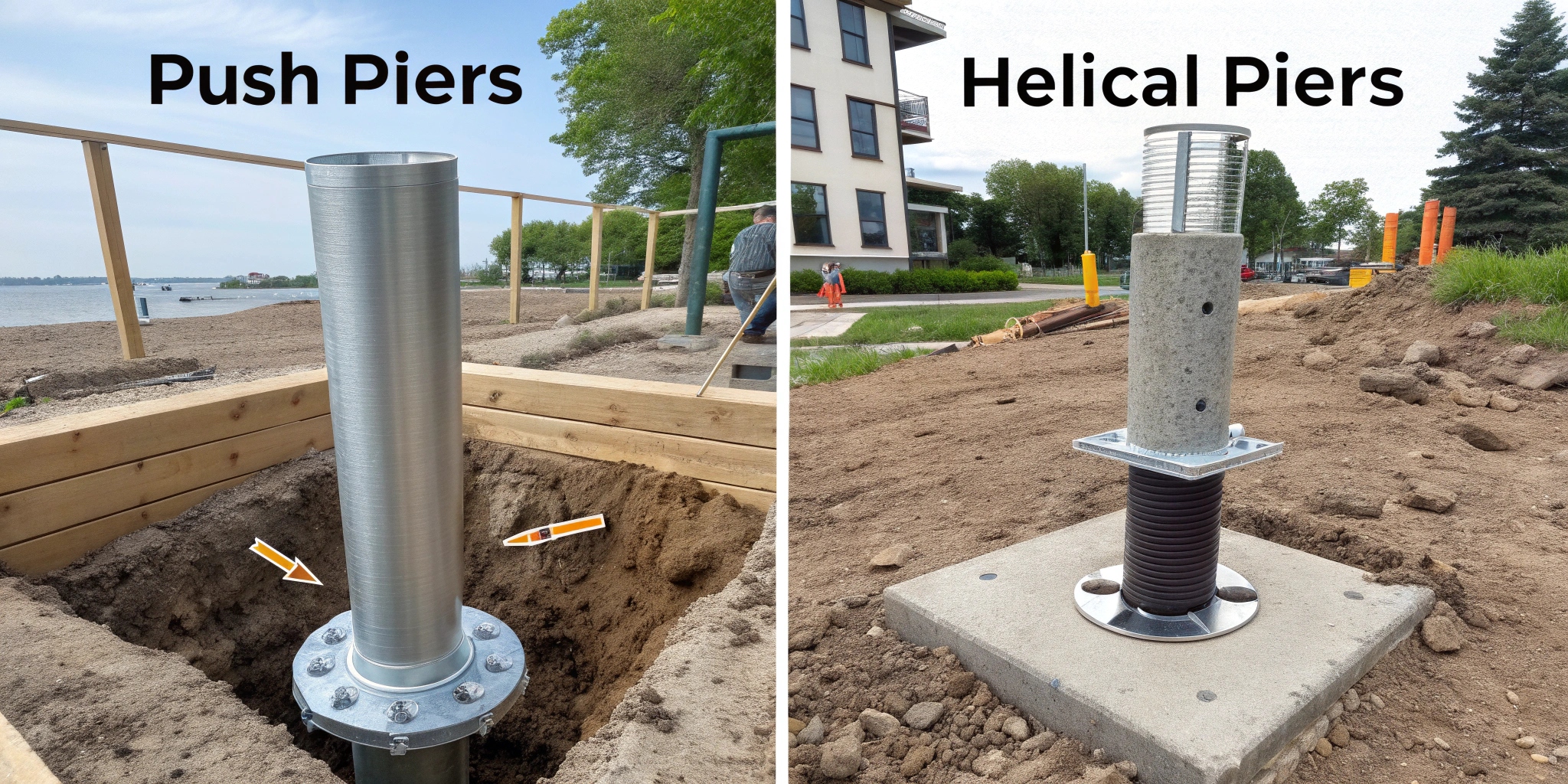
Push piers vs helical piers: what’s the difference?
The simplest answer: push piers are like nails; helical piers are like screws. One is driven, one is screwed. Both systems provide additional support to foundations experiencing settlement by transferring the load to stable soil beneath the problem area. They can lift or stabilize your foundation and are relatively easy to install without large machinery.
Key differences between push piers and helical piers
- Push piers: Also called resistance piers, they are hydraulically driven (pushed) deep into the soil using your house’s weight for resistance. They are installed parallel to your foundation and attached after being driven into the ground.
- Helical piers: These are hydraulically screwed into the soil with powerful drive motors. They are installed first and then attached to your foundation using a bracket. They often go in at an 8–10 degree angle and feature round plates (helices) to create the screw effect.
- Push piers require a heavy structure to drive them deep, while helical piers are ideal for lighter structures or loose, loamy soil.
Which pier works best?
- Push piers: Best for heavier structures and soils with good bearing capacity. Not ideal if the house is too light or soil is very loose or wet.
- Helical piers: Ideal for lighter structures and loose soil conditions. Not suitable for very dense or rocky soil where screwing them in becomes difficult.
Do pier coatings matter?
Both pier types are made of steel, which can rust over time. Most piers are powder coated or galvanized to extend their life 50+ years. In deep soil, oxygen is limited, slowing corrosion. For long-term durability, galvanized coatings are recommended.
How many piers are needed?
The number of piers depends on:
- The type of soil beneath your home
- The strength and depth of your foundation footings
- The total load your foundation carries
Even though a few piers could theoretically support the house’s weight, more are often required to prevent the footing from fracturing.
Why is one contractor suggesting only helical piers?
Helical piers are often recommended for lighter structures, such as one-story homes with shallow footings. If a contractor only suggests helical piers, it might also indicate they lack the equipment or experience to install push piers. A qualified contractor should evaluate both options based on soil conditions and structural weight.
Want to know more?
Foundation Tech, Inc. specializes in structural and foundation repair across Southern California. Contact them to assess your foundation and determine the best solution for your needs.