
Foundation Waterproofing in Desert Climates:
A Homeowner’s Guide
If you live in Arizona’s southern desert or California’s Inland Empire, you’ve probably never given desert foundation waterproofing a second thought. It barely rains in places like Phoenix, Tucson, and Riverside. So why worry about water damage?
Here’s the truth: desert homes are more vulnerable than you think.
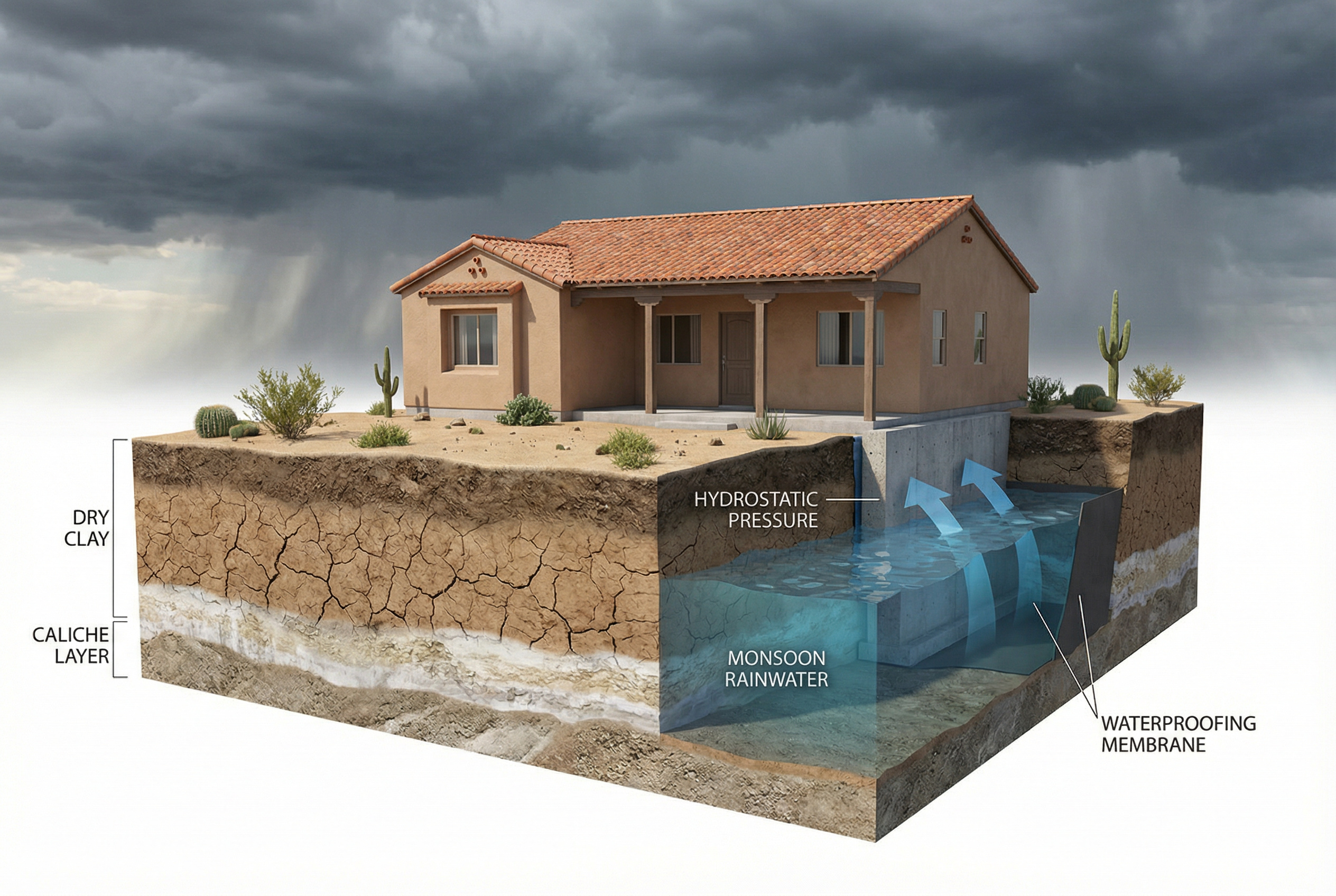
The soil across much of the Southwest is hard, compacted clay. When a monsoon hits, that clay doesn’t absorb water—it repels it. Rainwater rushes across the surface and pools around your foundation. It pushes against your concrete with tremendous force. Engineers call this hydrostatic pressure. It can drive water through cracks you didn’t even know existed.
At BristolFX, we see more water damage during “dry” years than most people expect. Here is your guide to desert foundation waterproofing—and why it matters more than you think.
The “Clay Bowl” Effect
When your builder constructed your home, the crew dug a hole and poured the foundation. Then they filled the gap around it with loose soil known as backfill.
Here’s the problem: that loose backfill soaks up water much faster than the surrounding desert ground. Every time it rains—or you water your lawn—water flows into the backfill. It collects against your foundation walls.
Your home essentially sits in a “clay bowl.” Dense desert soil traps the water in. Your foundation absorbs the pressure.
Understanding Caliche: The Hidden Threat Beneath Your Foundation
If you live in the desert Southwest, your home likely sits on caliche. Caliche is a cement-like layer of calcium carbonate. It forms naturally beneath the surface soil throughout Arizona and Southern California. It can range from a thin crust to a rock-hard slab several feet thick.
Many homeowners assume caliche blocks water. In reality, it creates a serious drainage problem. When monsoon rain, irrigation water, or a plumbing leak reaches the caliche layer, it has nowhere to go. The water cannot drain through the hardpan. Instead, it spreads sideways and saturates the soil beneath your foundation.
This saturation destabilizes the ground your home rests on. The trapped moisture causes soil to expand, shift, and lose its load-bearing capacity. Over time, this leads to slab cracks and structural movement. The worst part is that this damage happens slowly and out of sight. By the time you notice signs inside your house, the soil has already changed significantly.
Waterproofing vs. Damp-Proofing: Know the Difference
Most builders only apply damp-proofing during construction. That falls far short of true desert foundation waterproofing. Damp-proofing is a thin, black spray coating. It meets the bare minimum building code and breaks down over time.
True waterproofing goes much further and involves two key components:
Membranes — A thick, rubberized sheet applied to the exterior of your foundation wall. It creates a durable barrier that blocks water from reaching the concrete.
Drainage Boards — Dimpled plastic sheets that sit over the membrane. They create a small air gap. Water flows down through this gap to the footing level instead of pressing against your wall.
Together, these two layers give your foundation lasting protection—not just a temporary coating.
The Vapor Barrier Under Your Slab: What It Does and What It Doesn’t
For the past 30 years, building codes have required a thin plastic vapor barrier beneath the slab. This polyethylene liner prevents moisture vapor from migrating up through the slab. It keeps your floors dry and protects interior flooring materials.
However, this vapor barrier does not waterproof your entire foundation.
The liner only covers the underside of the slab. Your foundation footing sits outside that protection. Builders pour the footing directly onto native soil or a compacted sand base. No waterproof barrier separates the concrete from the ground.
Water in the surrounding soil can wick up through the footing. This process is called capillary action. Concrete is naturally porous. Moisture travels upward the same way water climbs through a paper towel. Once it reaches the stem wall, it can cause efflorescence, spalling, mold growth, and long-term structural deterioration. Meanwhile, the slab above the vapor barrier appears perfectly dry.
In desert climates, caliche traps water beneath the surface. The soil around your footing can stay saturated for weeks after a storm. That gives moisture plenty of time to work into your foundation. The vapor barrier was never designed to stop this. That is why additional waterproofing and drainage are so important.
Polyurethane Foam Injection: A Modern Alternative
Traditional membranes are highly effective but not always practical. Applying one to an existing home means excavating around the entire foundation. That can be time-consuming, disruptive, and expensive.
Polyurethane foam injection offers a powerful alternative.
This two-part resin gets injected into cracks, joints, and voids from the interior side. When the components mix, the foam expands rapidly. It fills gaps and forms a dense, waterproof seal bonded directly to the concrete.
Here is what makes polyurethane foam ideal for desert foundations:
Flexibility — Rigid sealants crack when your foundation shifts. Polyurethane foam stays flexible after curing. It moves with your concrete through desert temperature cycles and maintains its seal.
Rapid Curing — The foam sets within minutes. Technicians can complete most jobs in a single day with minimal disruption.
Chemical and Moisture Resistance — Cured polyurethane foam resists water, soil chemicals, and alkaline conditions. It handles the caliche-rich soils common in the desert. It won’t break down or wash away.
Targeted Application — A technician injects foam precisely where the intrusion occurs. No excavation is needed. This makes it ideal for addressing specific problem areas on a budget.
Polyurethane foam does not replace proper exterior drainage. However, when combined with a sound drainage strategy, it becomes a key component of any desert foundation waterproofing plan.
Your First Line of Defense: Proper Drainage and Grading
Before investing in any desert foundation waterproofing system, address the two most fundamental defenses: surface grading and French drains. These two measures alone can eliminate most moisture problems.
Surface Grading
The ground around your home should slope away from the foundation in every direction. Professionals recommend a minimum drop of six inches over the first ten feet. This grade directs rainwater, irrigation runoff, and monsoon flooding away from your walls.
Grading issues are among the most common problems we find during inspections. Landscaping projects, erosion, and settling can flatten or reverse the original grade over time. When the ground slopes toward your foundation, every drop of water funnels to the worst possible spot.
Correcting your grading is one of the most cost-effective steps you can take. Regrading the soil around your home and extending downspouts further from the walls can dramatically reduce moisture pressure.
French Drains
Grading alone cannot handle every situation. Caliche often prevents water from draining naturally. This is where a French drain becomes essential.
A French drain is a perforated pipe in a gravel-filled trench at your footing level. It collects water at the lowest point around your home and channels it to a safe discharge point.
Without one, trapped water has nowhere to go. It pushes up through your slab or forces through your basement walls. A French drain gives that water a clear exit path before it builds pressure.
Proper grading and a French drain work as a team. Grading keeps water from reaching the foundation. The French drain catches whatever makes it through. Together, they substantially reduce water intrusion risk.
Signs Your Foundation Already Has a Moisture Problem
You don’t need to wait for a flood. Watch for these warning signs:
Efflorescence — White, chalky powder on your stem wall or slab edges. Water seeps through the concrete, dissolves internal salts, and leaves them on the surface as it evaporates.
Musty Smells — A persistent musty odor means moisture is trapped nearby. This happens even in dry climates.
Spalling — Concrete flaking or crumbling at the base of your walls. Water has entered the concrete and is breaking it apart from within.
Sticking Doors and Windows — Moisture destabilizes the soil beneath your foundation. The resulting movement shifts frames out of alignment.
Cracks in Drywall or Stucco — Diagonal cracks above doorways or along exterior stucco signal foundation movement. Moisture-related soil shifts are often the cause.
If you notice any of these signs, moisture is already working against your foundation.
Protect Your Home Before the Next Monsoon
Foundation water damage doesn’t start with a dramatic flood. It begins quietly. A faint smell. A white stain on the wall. A small chip in the concrete. By the time you notice, the damage is underway.
Don’t wait for the next monsoon to test your foundation. Efflorescence, damp spots, or crumbling concrete all mean moisture intrusion is already happening. It will only get worse.
BristolFX offers comprehensive desert foundation waterproofing inspections across Arizona’s southern desert and California’s Inland Empire. We don’t just patch the crack. We identify the water source, evaluate your soil and drainage conditions, and design a lasting solution.
Whether you need grading corrections, a French drain, polyurethane foam injection, or a full exterior membrane, our team will recommend the right approach for your property and budget.
Schedule Your Waterproofing Inspection Today