
Foundation Drainage, Soil Types, and Structural Integrity
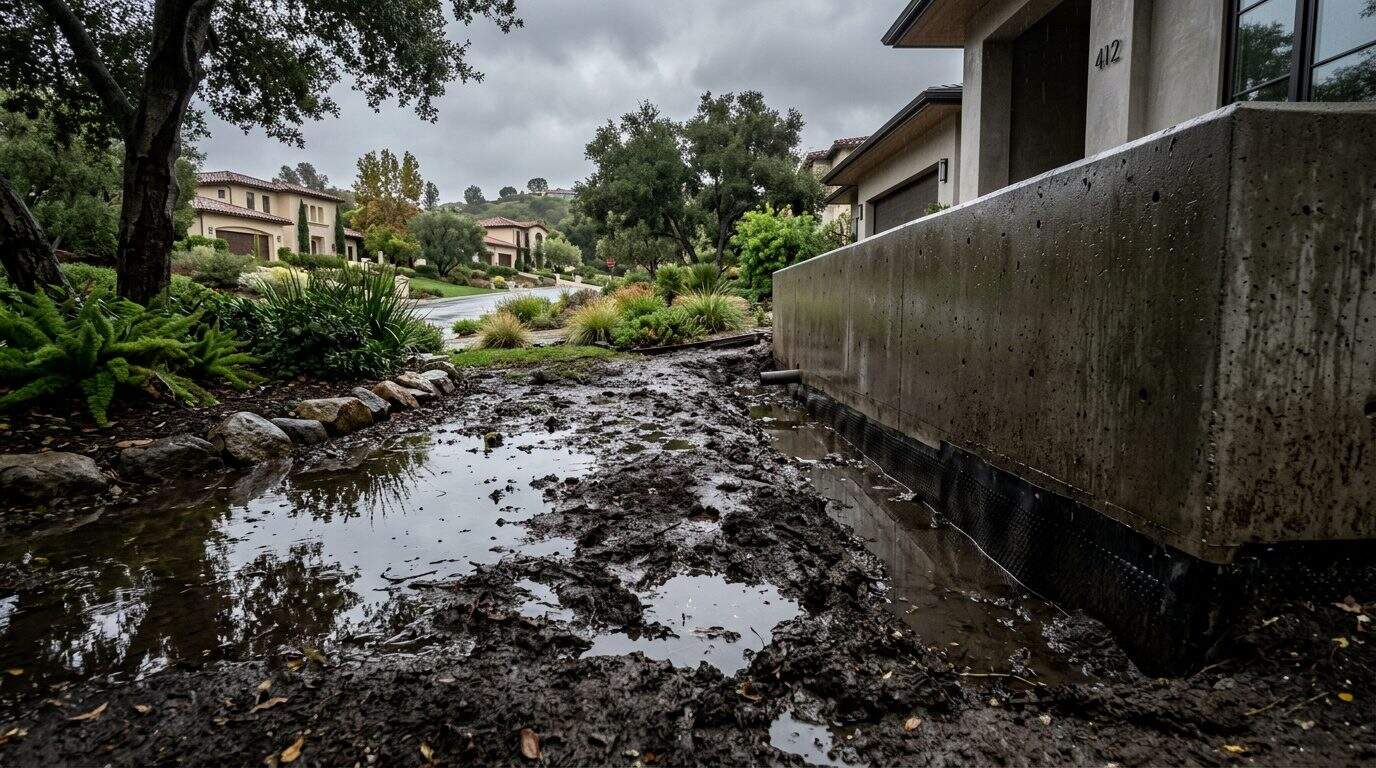
Standing water against a foundation after heavy rain — the #1 sign of foundation drainage failure.
Foundation drainage problems are the leading cause of structural damage in Southern California and Arizona homes. When water has nowhere to go, it saturates the soil beneath your foundation — and the soil itself begins to fail. This article explains how foundation drainage interacts with different soil types, what warning signs to watch for, and why the right repair approach depends on understanding both.
Inadequate Drainage and Soil Consolidation
Inadequate foundation drainage occurs when the topography is flat, slopes toward the house, or puddles near closed planters. When irrigation volume is unnecessarily high or torrential rains occur, it creates “ponding” conditions where water has no escape route.
- Soil Consolidation: Water percolates through topsoil to saturate subgrade soil, making it more compressible. This is common in most soil types but most prevalent in clay.
- Plumbing & Gutters: Rain gutters draining adjacent to the foundation or excessive hose use can saturate the soil, leading to movement. Proper drainage correction redirects this runoff before it reaches the foundation.
Soil Classification and Plasticity
The Plasticity Index (PI) measures the range of water contents where soil exhibits plastic properties. A higher PI indicates a greater potential for foundation problems.
- Sandy Soil: Small particles of weathered rock with poor water-holding capacity. Usually experiences little settlement.
- Silty Soil: Smooth, fine particles that hold water better than sand; often found in lowland valleys or near lakes.
- Loamy Soil: A combination of sand, silt, and clay including humus. It has a high probability of soil consolidation.
- Clay (Clayey Soil): Tightly packed particles that expand when moist and shrink significantly when dry, leading to differential settlement.
Signs of Foundation Drainage and Settlement Problems
Identifying structural issues early is key to preventing severe damage. Common warning signs include:
- Interior: Cracked walls (especially in corners or the ceiling), stuck doors or windows, and sinking or uneven floors.
- Kitchen/Bath: Counters or cabinets pulling away from the wall and cracks forming in countertops.
- Exterior: Leaning chimneys, vertical cracks in the foundation, and windowsills or moldings pulling away from the wall.
- Systems: Recent or past sewer line replacements may also indicate movement.
The “Optimal Moisture” Goal
“Water is our best friend, and our worst enemy.”
- Extreme Winters: Excess moisture can cause upward heaving or rapid settlement if soil becomes unable to support the load.
- Hot Summers/Drought: Foundation settlement occurs as moisture decreases and soil becomes more compressible.
- Loamy Soil Change: Moisture fluctuations can cause elevation changes of up to four inches in loamy soil.
How Bristolfx Solves Foundation Drainage Problems
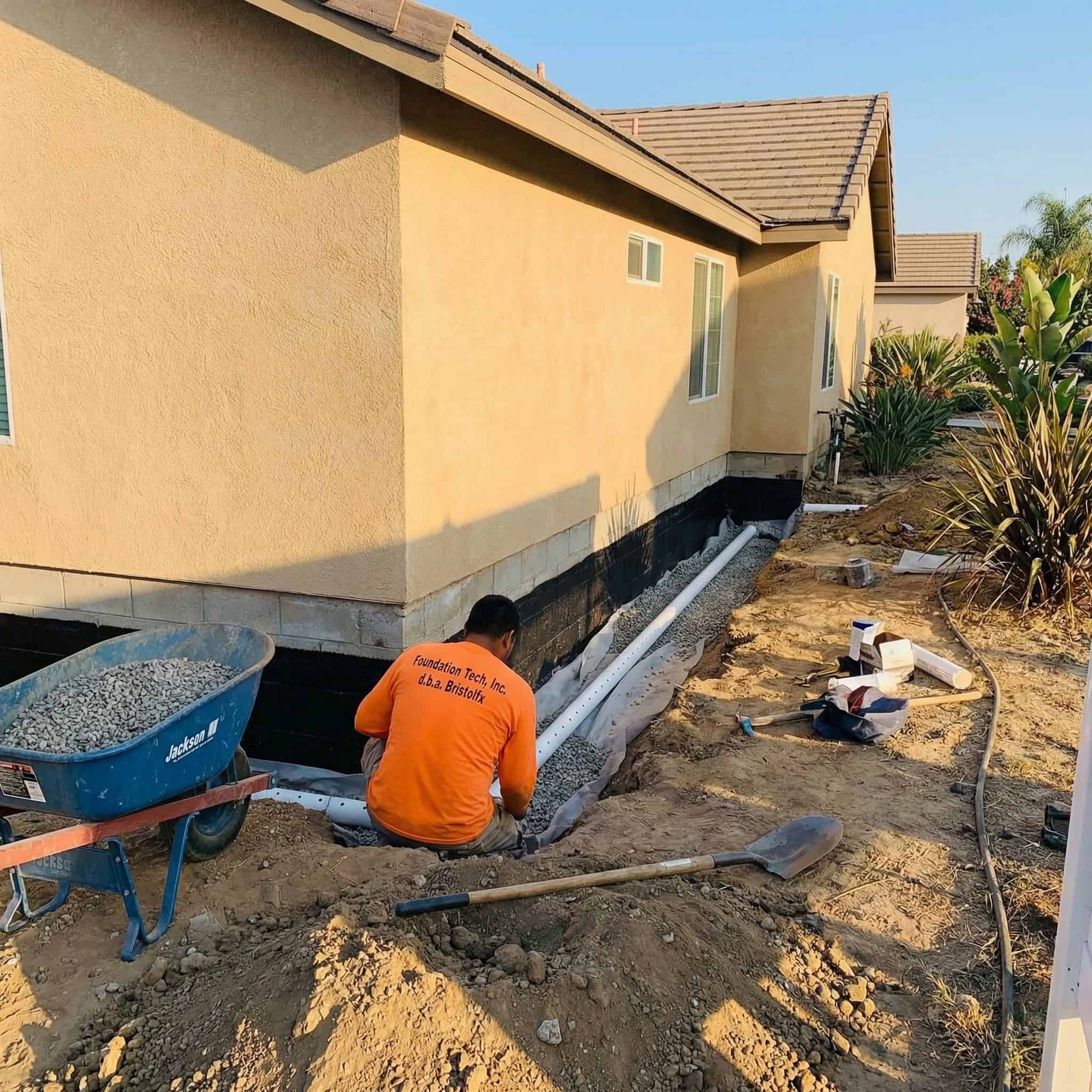
A Bristolfx crew installing French drains at a Southern California home to correct foundation drainage problems.
The right fix depends on the source of the water. For most Southern California and Arizona homes, the answer is a combination of surface drainage correction and below-grade French drain systems that redirect groundwater away from the foundation before it can saturate the soil. In severe settlement cases, push piers or helical piers are added to permanently transfer the home’s load down to stable bearing soil or bedrock.
Additional Structural Loading
Upgrades can significantly increase foundation stress beyond the original design:
- Roofing: A tile roof can add five times the load of a composite roof and ten times the load of a cedar shake roof.
- Additions: Second-story additions can more than double the foundation load.
- Masonry: Brick or stucco siding adds thousands of pounds per lineal foot.
- Interior Changes: Removing an interior wall can increase the load on the remaining vertical sections by up to ten times.
The Science of Settlement (Newton’s Third Law)
Foundation settlement is the downward sinking caused by soil shrinking, wetting, or poor compaction.
- Action and Reaction: When a foundation settles, everything connected to it settles or separates.
- Framing Failure: As wall studs move down, roof rafters pull away from the ridge beam. This puts tension on framing nails; a 2-inch settlement can leave less than 1/4 inch of nail embedment, severely weakening the structure’s resistance to gravity and seismic forces.
Anatomy of a Properly Installed French Drain
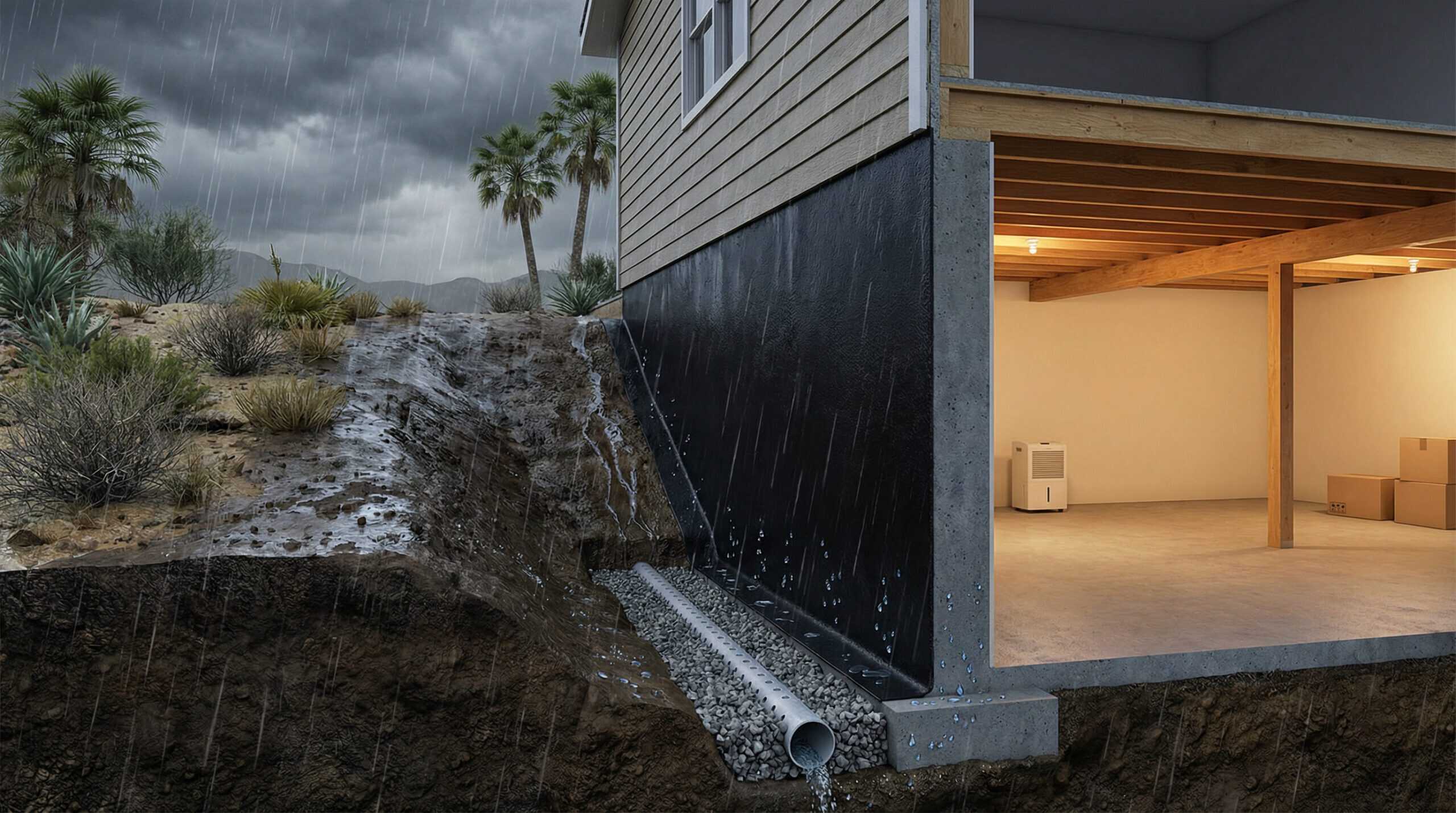
Cross-section diagram of a properly installed French drain protecting a foundation stem wall.
A properly installed French drain includes a perforated drainpipe, washed gravel, geotextile filter fabric, and waterproofing membrane — all designed to redirect groundwater away from the foundation. When installed correctly, this single solution prevents the soil saturation that drives foundation settlement, hydrostatic pressure, and stem wall cracking.
What to Do Next
If you suspect foundation drainage problems are damaging your home, don’t wait. These issues only get worse with time. Bristolfx has helped Southern California and Arizona homeowners protect their foundations for years, and we offer free inspections so you’ll know exactly what you’re dealing with before any work begins.
📞 Call Bristolfx today for a FREE foundation inspection.
California: (661) 294-1313 | Arizona: (928) 767-7789
📧 Or request your FREE inspection online.
© 2026 Foundation Tech, Inc. d.b.a. Bristolfx. All rights reserved.